A new upstream cargo terminal is set to transform Macao’s regional logistics role, with local authorities confident that the new infrastructure will strengthen logistic, trade and technology ties between Macao and the Chinese mainland.
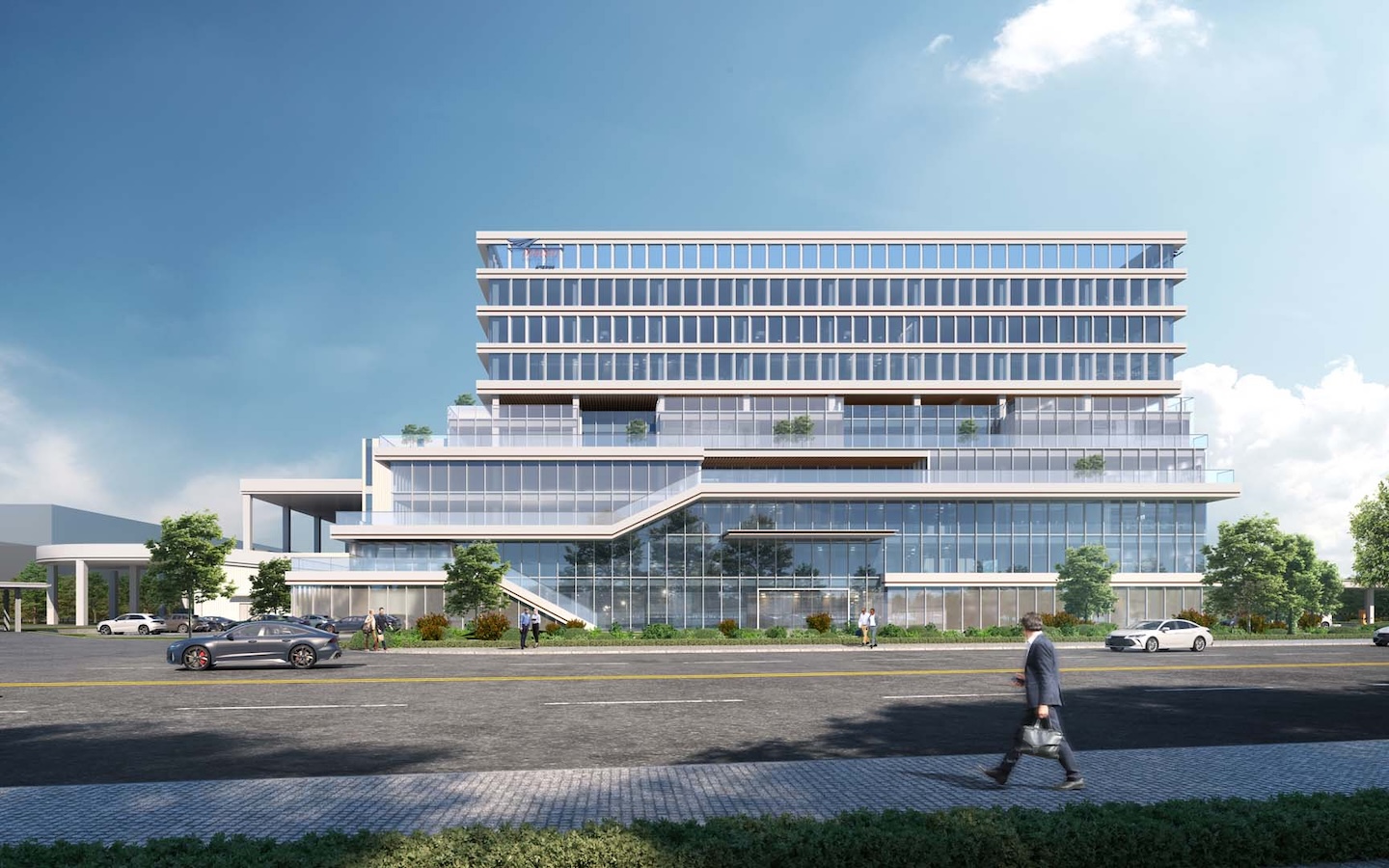
Targeted for completion by late 2026 and fully operational in 2027, the Macau International Airport Hengqin Upstream Cargo Terminal is designed to handle up to 300,000 tonnes per year. Once running, it will shift much of Macao’s air cargo service chain – security screening, pallet building and distribution – into Hengqin, enabling goods to flow smoothly onto flights at Macau International Airport.
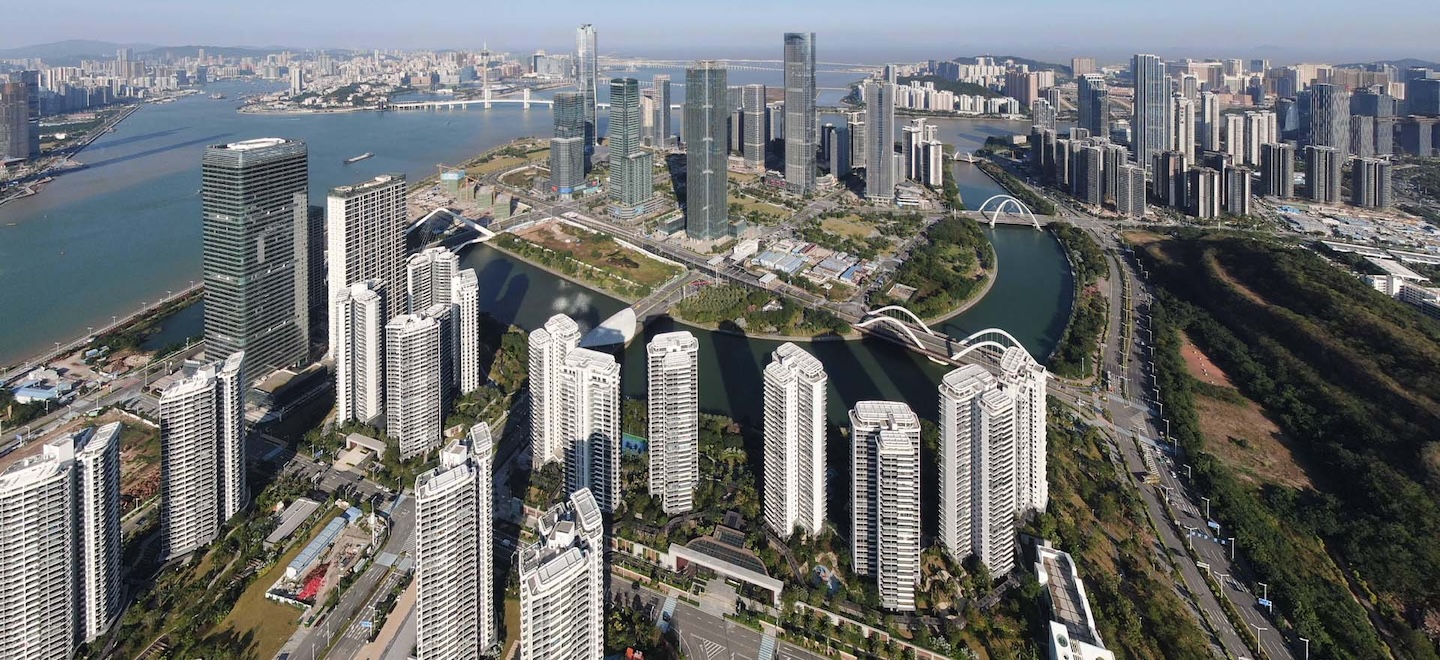
A ground-breaking ceremony for the project on October 28 marked a major milestone. Designed to expand Macao’s air cargo capacity and integrate more closely with the Guangdong-Hong Kong-Macao Greater Bay Area, the 97,600-square-metre complex is located on a 66,700-square-metre plot in neighbouring Hengqin.
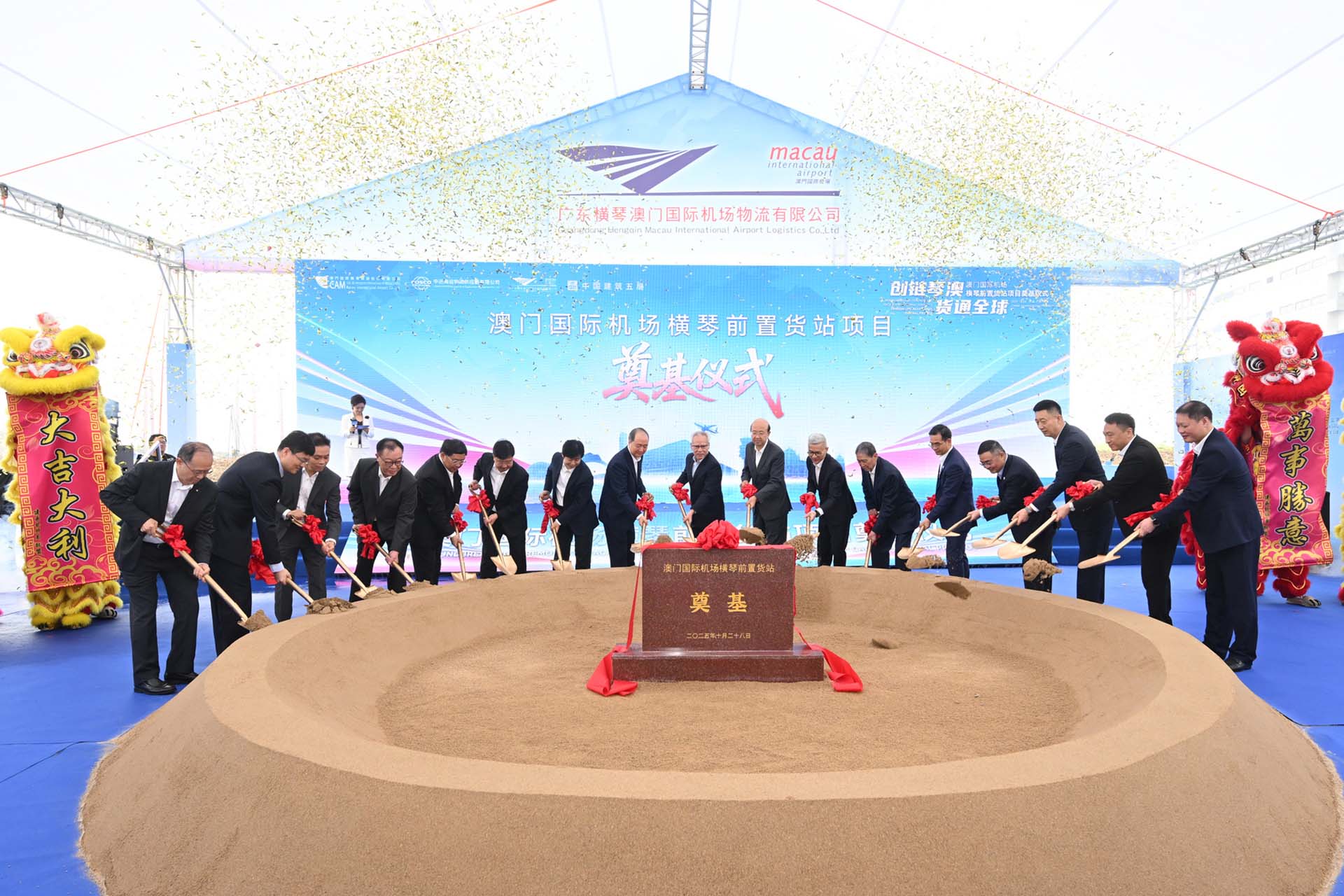
The 700-million yuan project is being developed by Guangdong Hengqin Macau International Airport Logistics Co. Ltd., a joint venture between the Macau International Airport Co. Ltd. (CAM) and COSCO Shipping Logistics & Supply Chain Management Co. Ltd.
CAM executives stressed that this is not just an expansion to complement Macao’s airport – it is an evolution. “The Hengqin upstream terminal is not just an expansion of facilities, it is a structural upgrade to Macao’s logistics system,” a company representative told Macao Magazine. “By extending our service chain into Hengqin, we are building the foundation for Macao to become a regional air logistics hub.”
Recent data underscore the growing demand behind the project. According to Macao’s Statistics and Census Service, gross weight of land-based containerised cargo (60,632 tonnes) and air cargo (87,674 tonnes) rose respectively by 8.0 percent and 1.7 percent year-on-year in the first ten months of 2025, while the volume of port cargo declined.
Meanwhile, Hengqin’s total imports and exports soared by 101.5 percent year-on-year in the first half of 2025, to about 22.48 billion yuan, according to the Hengqin authorities. The value of exports rose 104.2 percent from the comparable period a year earlier, to 13.80 billion yuan, while imports reached nearly 8.68 billion yuan, up 97.3 percent from the first half of 2024.
The surge, suggested the Hengqin authorities, was fuelled by policies promoting investment, cross-boundary e-commerce, financial innovation and deeper integration with Macao.
Relieving space constraints
The new terminal is envisioned as a key building block in an integrated Macao–Hengqin logistics corridor. With Hengqin only a half-hour drive from Macau International Airport via the Lotus Bridge, shifting core cargo processing activities out of Macao will finally give the airport breathing room.
CAM emphasised how pivotal this shift will be. “Our airport has limited land resources. Moving core functions such as security checks and palletising to Hengqin allows us to multiply our handling capacity while maintaining compliance with international safety standards,” the airport operator explained.
Hengqin’s special customs supervision system will further accelerate cross-boundary flows. CAM noted the benefits of streamlined coordination: “Through dual-line management, customs information sharing and one-stop inspection, clearance procedures will be simplified, reducing costs and improving efficiency for businesses.”
The so-called “dual-line management” – or two-line customs management – is a pioneering customs supervision system that came into effect on March 1, 2024, in the Guangdong-Macao Intensive Cooperation Zone in Hengqin. The policy aims to facilitate integrated development by promoting the efficient flow of people, goods, capital, and information between the two regions.
The “first line”, between Macao and Hengqin, prioritises the efficient and convenient movement of people, while goods enjoy relatively free circulation, including duty-free under certain conditions. The “second line” is between Hengqin and the rest of the Chinese mainland, primarily controlling the movement of goods, with the unrestricted movement of people.
In his 2026 Policy Address, Macao Chief Executive Sam Hou Fai stressed the importance of developing the Macao Pearl River West Bank International Air Transport Hub (Port) – including the Hengqin cargo terminal and the expansion of the Macau International Airport – as a way to enhance the scale and competitiveness of Macao as an international air transport hub, helping Macao make greater contributions to the country’s opening up to the outside world.
Mr Sam, who is also co-director of the Cooperation Zone’s administrative committee, a governing body responsible for making major policy, highlighted that Macao will pursue a higher level of opening-up to further integrate into the country’s overall development and deepen the development of the Greater Bay Area.
The aim is to boost the city’s competitive advantage, helping to diversify Macao’s economy and strengthen the logistics ties between China and Portuguese-speaking countries, as well as with the nations covered by the “Belt and Road” initiative.
Releasing the bottleneck
Lou Shenghua, professor at the Faculty of Humanities and Social Sciences of the Macao Polytechnic University, said the new cargo terminal directly addresses Macao’s limited land supply, which constrains the city’s logistics ambitions. “Macao simply does not have enough physical space for large-scale cargo operations,” he noted. “By transferring core functions to Hengqin, the city effectively multiplies its handling capacity.”
CAM echoed this view, highlighting the broader reach the project will have. “With Hengqin’s connectivity, our cargo collection network can extend beyond Macao into the Pearl River Delta and western Guangdong,” the company said. “This is a fundamental shift in how Macao participates in regional supply chains.”
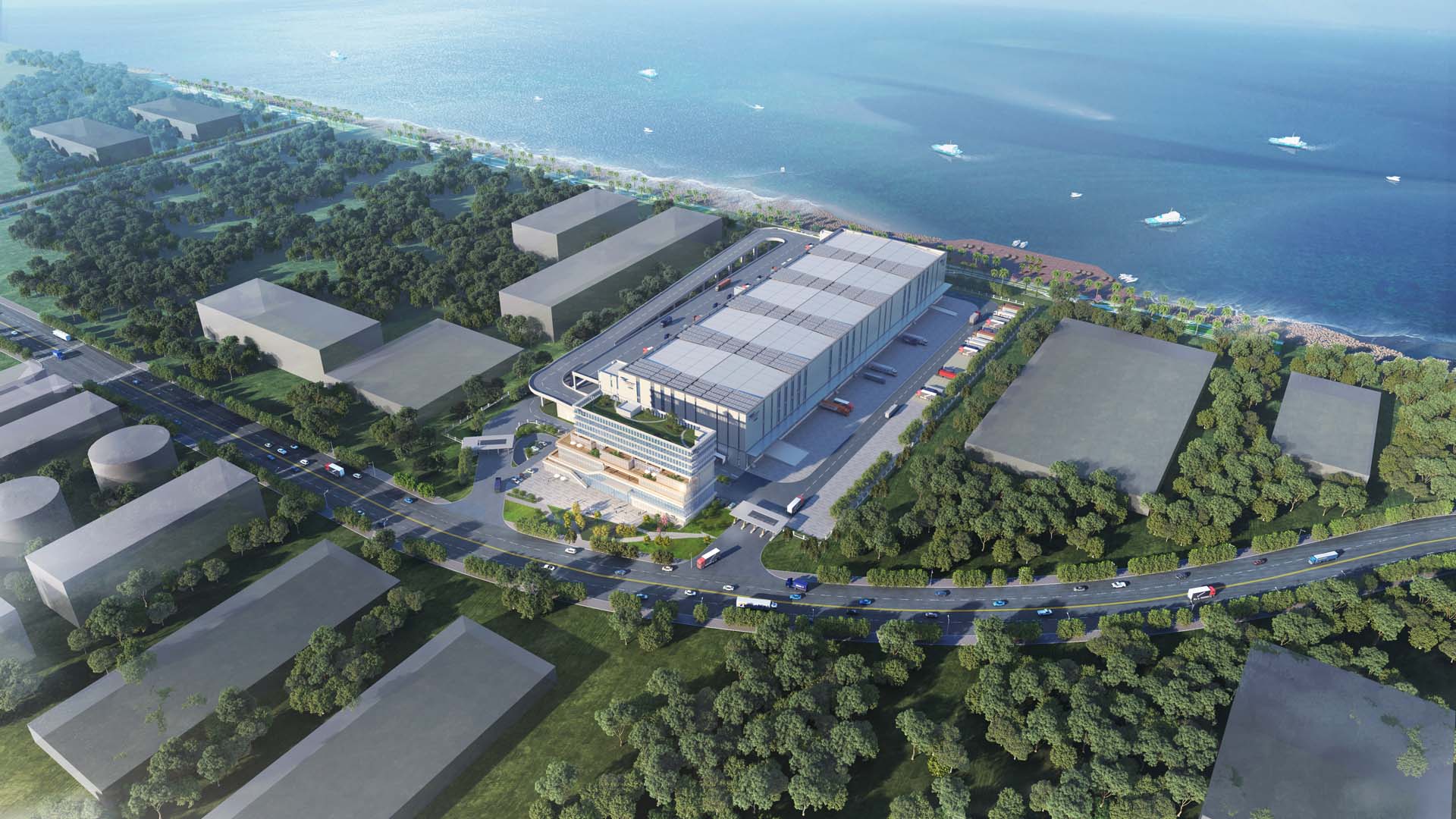
The new setup is expected to cut logistics costs significantly, according to project planners, as goods can be screened and prepared in Hengqin, then delivered to the Macau International Airport and lifted within half a day.
Professor Lou estimates substantial operational savings for businesses using the new system. “Based on our analysis, companies may see their logistics costs fall by 20 to 30 percent,” he stated. “This kind of efficiency will make Macao a far more attractive transit point for international freight.”
CAM reinforced this point, noting that efficiency gains will be critical for attracting new clients. “Time-sensitive and high-value cargo operators are increasingly demanding streamlined processes. This terminal allows us to meet those demands while positioning Macao as a competitive alternative to other regional hubs,” the airport operator observed.
Building a modern logistics system
The terminal is also closely aligned with Macao’s broader economic diversification goals, as well as further integration within the Greater Bay Area. Its dual-node model – processing in Hengqin, take-off in Macao – marks a shift toward a more integrated logistics architecture.
Professor Lou called the approach transformative: “The efficient linkage between Hengqin and the airport enables Macao to evolve from a single-node airport logistics service into an integrated, networked system.”
As Macao positions itself as a platform for trade with Portuguese-speaking countries, CAM highlighted the strategic advantages. “A complete cargo chain makes it more convenient for products from markets of Portuguese-speaking countries to enter China via Macao, while also facilitating outbound flows to Portugal, Brazil, Angola and beyond,” the company said.
The upstream terminal is also tailored for future-oriented industries, such as biomedicine, advanced manufacturing and cross-boundary e-commerce – all sectors that depend on speed and reliability. “Industries such as e-commerce and biomedicine need fast, reliable logistics solutions. The new terminal offers customised services for these sectors, creating a virtuous cycle where industry drives logistics and logistics supports industry,” CAM noted.
Once operational, the terminal is expected to streamline cargo flows between Macao, Hengqin and the wider Greater Bay Area, acting as a powerful logistics engine linking businesses across Guangdong and Macao. Officials say the facility will act as an “air corridor” connecting various emerging industries throughout the region.
For Macao, however, the terminal’s significance goes beyond logistics. It represents a shift toward a more resilient and diversified economy. “This facility deepens the integration of logistics, commercial flow and information flow between Macao and Hengqin,” CAM said. “It positions Macao to participate more actively in regional development while enhancing its competitiveness as an international logistics platform.”
Professor Lou added that the project could reshape Macao’s economic landscape for the next decade. “It positions Macao to move beyond its traditional reliance on tourism and gaming, embedding the city into the industrial and logistics fabric of the Greater Bay Area,” he said.
With operations expected in less than two years, the upstream cargo terminal is poised to become one of the Greater Bay Area’s most influential cross-boundary logistics developments – one that promises speed, cost savings and a new economic chapter for Macao.
“This project is a milestone for Macau International Airport. It represents our commitment to innovation, efficiency and regional cooperation. By integrating Hengqin into our logistics chain, we are ensuring that Macao remains a vital node in the Greater Bay Area’s global connectivity,” CAM concluded.