
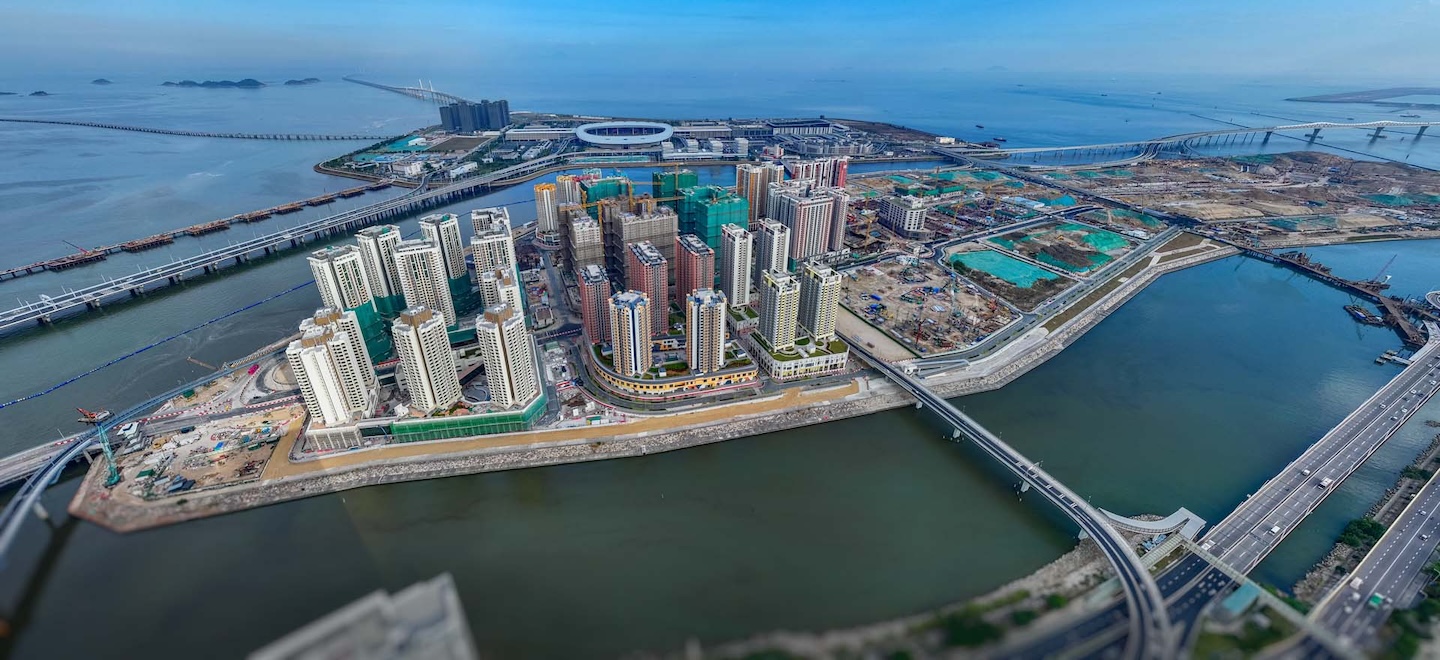
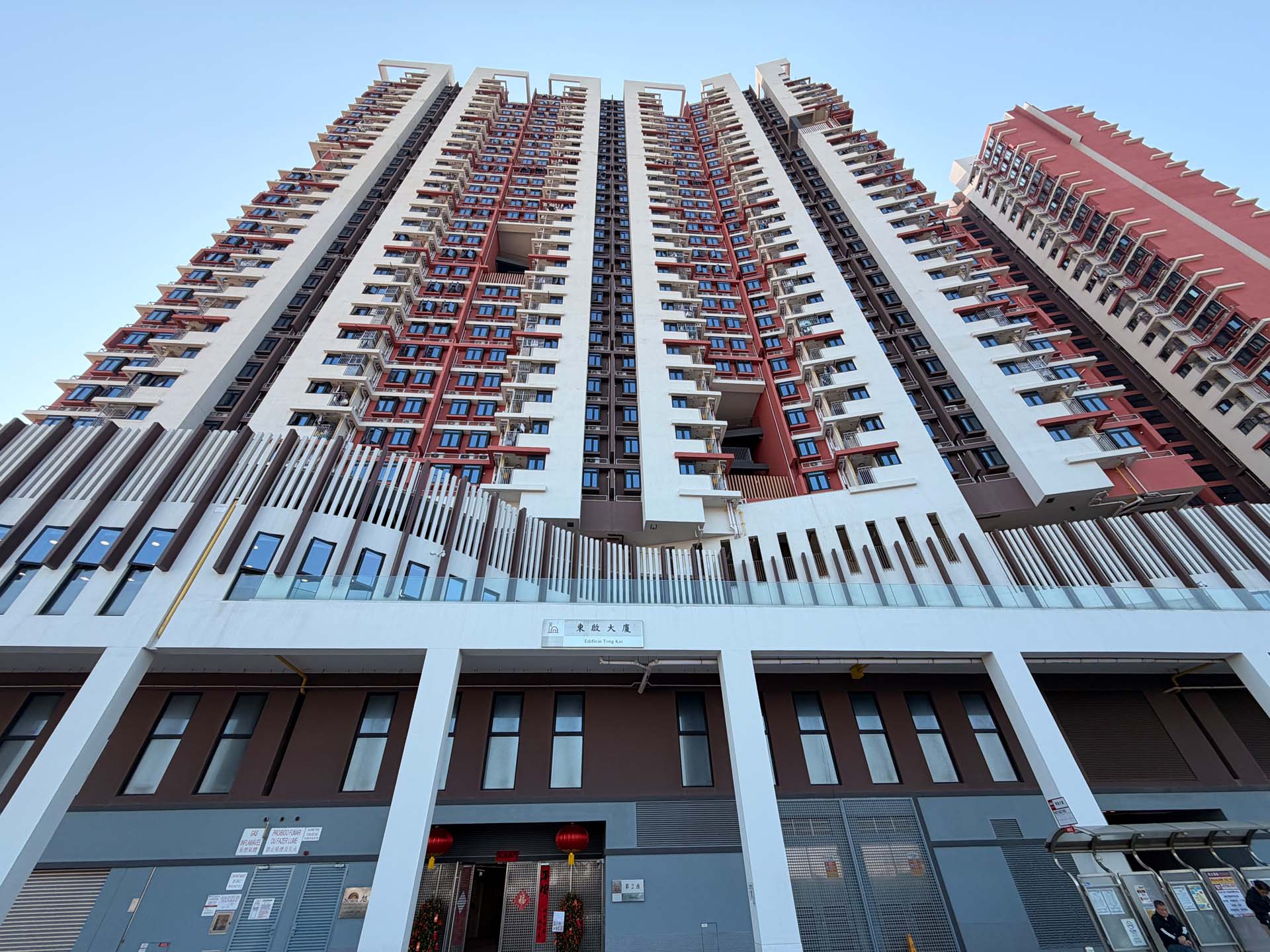
From Areia Preta, the sea stretches outward, with the Hong Kong–Zhuhai–Macao Bridge standing on the horizon. Nearby, high-rise towers cloaked in green safety netting rise steadily, while construction sites hum with the rhythm of trucks and workers in motion. This is the usual scene university student Jason Lei passes each day on his way home to Tong Kai building in Macao’s New Urban Zone A.
Jason Lei moved into the flat with his parents at the start of the year and is still finding his footing. “It’s definitely more spacious here, as it is new, still developing,” he noted. “In just over two months … I’ve already seen more people moving in.”
He is part of the first wave of residents settling into the city’s new district, one of Macao’s five reclaimed urban zones. Designed to eventually house close to 100,000 people, the area is envisioned as a fully integrated community, blending residential living with commerce, culture, leisure and transport.
The five reclaimed zones – A to E2 – trace their origins to a 2009 land reclamation project aimed at expanding Macao’s total area. Zone A, the largest at 1.38 square kilometres, completed its main land formation and seawall works in 2017, laying the groundwork for vertical growth.
In 2024, the Macao Special Administrative Region (MSAR) Government formalised its blueprint in the Official Gazette through the Detailed Plan for Eastern District-2. The plan outlines land use across the area, positioning it as a liveable neighbourhood, a commercial hub and a waterfront landmark. It also highlights broader goals: advancing housing policy, diversifying the region’s economy, building greener spaces, enhancing waterfront access, prioritising public transport and making use of underground infrastructure.
Of the 76 land plots, 49 – covering 433,649 square metres – are allocated for housing.
In time, will flourish
Even so, the first completed developments are beginning to translate vision into lived experience. Three parcels – home to Tong Kai, Tong Chong and Tong Seng buildings – were finished last year, welcoming their first residents. Data from Macao’s Housing Bureau showed that a total of 2,223 units – out of 3,017 dwellings in the three towers – had been sold as of mid-March, with most households already receiving their keys.
Leong Wai, a retiree in his 60s, moved with his family into Tong Chong building at the start of the year. For him, public housing offers stability, a welcome contrast to the fluctuations of private rents.
Like many early residents, he is adjusting to a neighbourhood still catching up in services. Every other day, he travels to nearby districts, such as Areia Preta or Iao Hon, for groceries. Without a car, he relies on buses, which he describes as “workable,” and improving. “The bus frequency has improved over the past few weeks. I can reach most parts of the city by taking buses and transferring between routes. Since I don’t go out during rush hour, it’s pretty good for me.”
Regarding amenities, his outlook is measured. With a small population so far, retail options remain limited, pushing residents to shop elsewhere. “But we’ve seen a new supermarket open recently,” he noted. “When more people live here, more businesses will open to meet demand.”
He draws a familiar comparison: “This area is like Taipa decades ago. There weren’t many people or businesses at first, but given time, it would flourish.”
Meeting day-to-day needs
Last year, to support early residents in New Urban Zone A, the MSAR Government tendered five commercial units earmarked for essential services such as a supermarket, pharmacy, eatery and bank. Incentives, including rent-free periods, were introduced to encourage businesses to set up in the still-developing district.
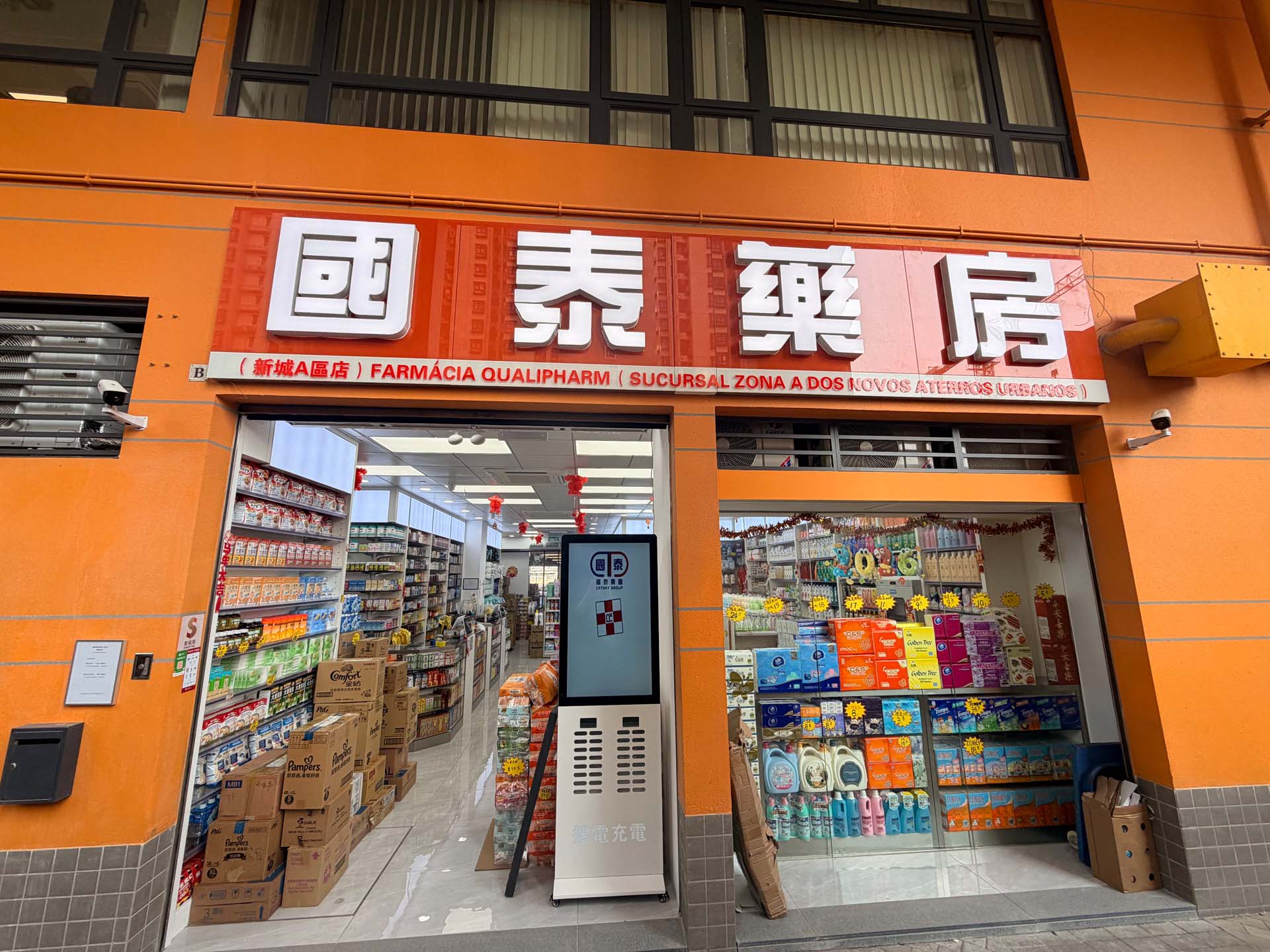
By February, two shops – a supermarket and a pharmacy – had already opened, according to a statement from the Housing Bureau. Authorities say they will continue to monitor occupancy and help remaining tenants complete licensing procedures.
“The MSAR Government is committed to improving facilities and supporting amenities in New Urban Zone A and will continue to monitor occupancy in the district,” the bureau stated. “We will press ahead with helping the remaining leased units complete procedures … with the aim of opening as soon as possible to better meet residents’ daily needs.”
A second batch of retail spaces is also in preparation, with another tender expected later this year. The mix will likely include food outlets, convenience stores and general retail, gradually reducing reliance on neighbouring districts.
Among the early arrivals is pharmacy Qualipharm, which opened its Zone A branch just before Lunar New Year. Business has been modest so far, reflecting the district’s gradual population growth.
“Compared with our other outlets, where we serve a mix of residents and tourists, this shop has mostly residents so far, especially older customers buying medication and supplements,” Ms Lau, a shop manager, said. “That’s expected. It’s still a very new area, and volume should pick up as more people move in.”
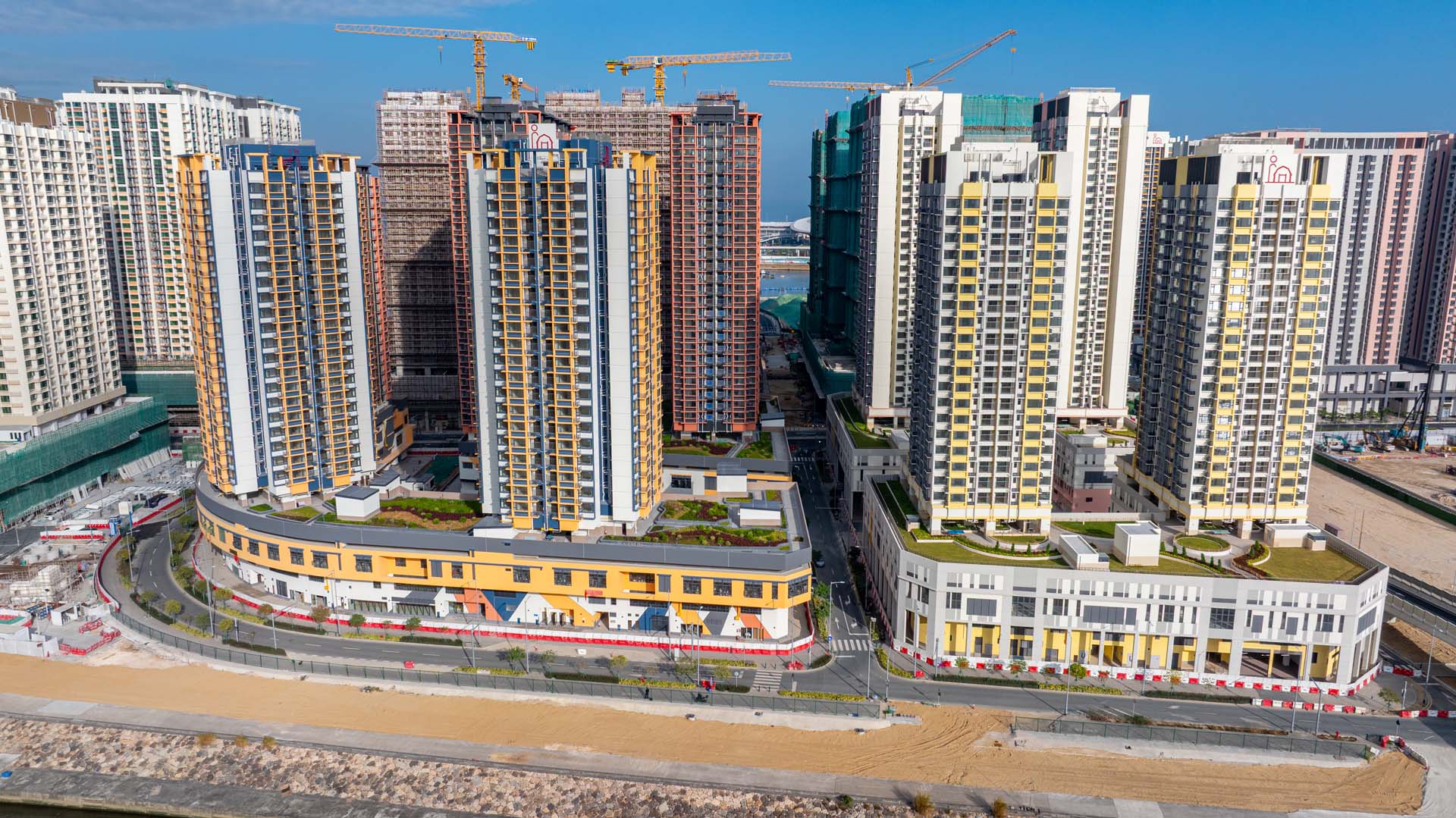
That growth is already underway. More housing projects are nearing completion, with thousands of additional units at various stages – from awaiting occupancy permits to interior fitting and structural construction – pointing to a steady rise in population in the coming years.
According to data from the Housing Bureau, three newly built affordable housing projects in the area – totalling 2,808 flats – have been completed and are awaiting the respective occupancy permits. Two other affordable housing projects, with 2,446 apartments, and four social housing developments, providing 4,088 homes, have been topped out, with interior fit-out work under way.
Further behind in the construction cycle, five additional affordable housing projects, providing 5,415 units, are now in the tower structure phase.
Social services support
Alongside commerce, a network of social services is beginning to take shape. Several organisations have established a presence in the district, offering support ranging from childcare to family services and vocational training. These include: a nursery run by the Macau Tung Sin Tong Charitable Society; a family and community integrated service centre run by the Macao Federation of Trade Unions (FAOM); and a Caritas Macau facility offering family support, vocational rehabilitation and developmental training.
Tam Kuai San, a deputy director at FAOM, describes their role as both practical and personal: offering emotional support and sharing daily life information. Just as important, she said, their staff keep close contact with residents during the transition period, proactively identifying their day-to-day issues and relaying feedback and recommendations to relevant Government departments.
“Our aim is to help ease practical inconveniences, reduce the stress of adjustment, and support residents as they build stability and a sense of belonging in this new neighbourhood,” Ms Tam explained.
Residents’ feedback so far has centred on familiar concerns, transport gaps, limited amenities and minor building issues, she added.
Transport remains both a challenge and an opportunity. While bus services are improving, attention is turning to the Light Rapid Transit (LRT) East Line, currently under construction. Once completed in 2029, it will link New Urban Zone A with Taipa and the northern districts, with trains running at short intervals during peak hours.
“The New Urban Zone A is still in the development phase, and residents are moving from ‘having a home’ to ‘living well’,” Ms Tam said. “As they navigate the adjustment challenges that come with a new environment, they’re also looking ahead to more spacious homes, better services and a higher quality of life.”
Service providers are adapting as well. Paul Pun Chi Meng, secretary-general of Caritas Macau, said that for organisations on the ground, the challenge lies in responding to evolving needs in a district still finding its rhythm. Facilities are expanding gradually, with new services – such as vocational training and childcare – already being introduced.
The Caritas Macau centre in the new district currently offers 100 places for vocational and skills training for people with intellectual disabilities and neurodivergent individuals. Since March, it began providing nursery services for families.
Quality of life
“When New Urban Zone A was first planned, the idea was to address the housing shortage. Now it’s no longer just about housing; it’s also about quality of life,” Mr Pun observed. “If people feel something is lacking, they should raise their views through the proper channels, and the Government will take those views on board and make improvements.”
The district’s early stage also presents opportunities to experiment. One example is the use of reclaimed water for non-potable purposes, a system more feasible to install here than in older neighbourhoods, and that will later be expanded to other reclaimed zones.
“There are also a lot of land resources in New Urban Zone A for development,” Mr Pun added. “These could translate into more sports, social and cultural facilities that lift everyday life for residents.”
The planning framework published in 2024 supports that potential. Beyond housing, three plots, with a combined area of 15,255 square metres, are earmarked for commercial use. Another 17 plots, totalling 207,722 square metres, are designated for public facilities, including government services, education, social services, culture, leisure and healthcare.
For legislator Song Pek Kei, this mix is key to the district’s long-term role.
“As a major integrated community and development zone for Macao’s future, New Urban Zone A carries higher expectations from society,” she said. “Beyond actively addressing residents’ needs, it should be planned in line with modern urban-development principles, with comprehensive facilities that can also facilitate the city’s economic diversification and integration with the Guangdong–Hong Kong–Macao Greater Bay Area.”
As a major integrated development area, New Urban Zone A is expected not only to meet residents’ needs but also to contribute to the city’s broader economic and social ambitions. Its proximity to the Hong Kong–Zhuhai–Macao Bridge positions it to attract both local activity and visitors, while demographic trends – such as an ageing population – underscore the need for more leisure spaces and elderly services.
“With land resources so precious, the Macao Government needs to make the best use of every inch of land to build a more liveable Macao,” Ms Song stated.