
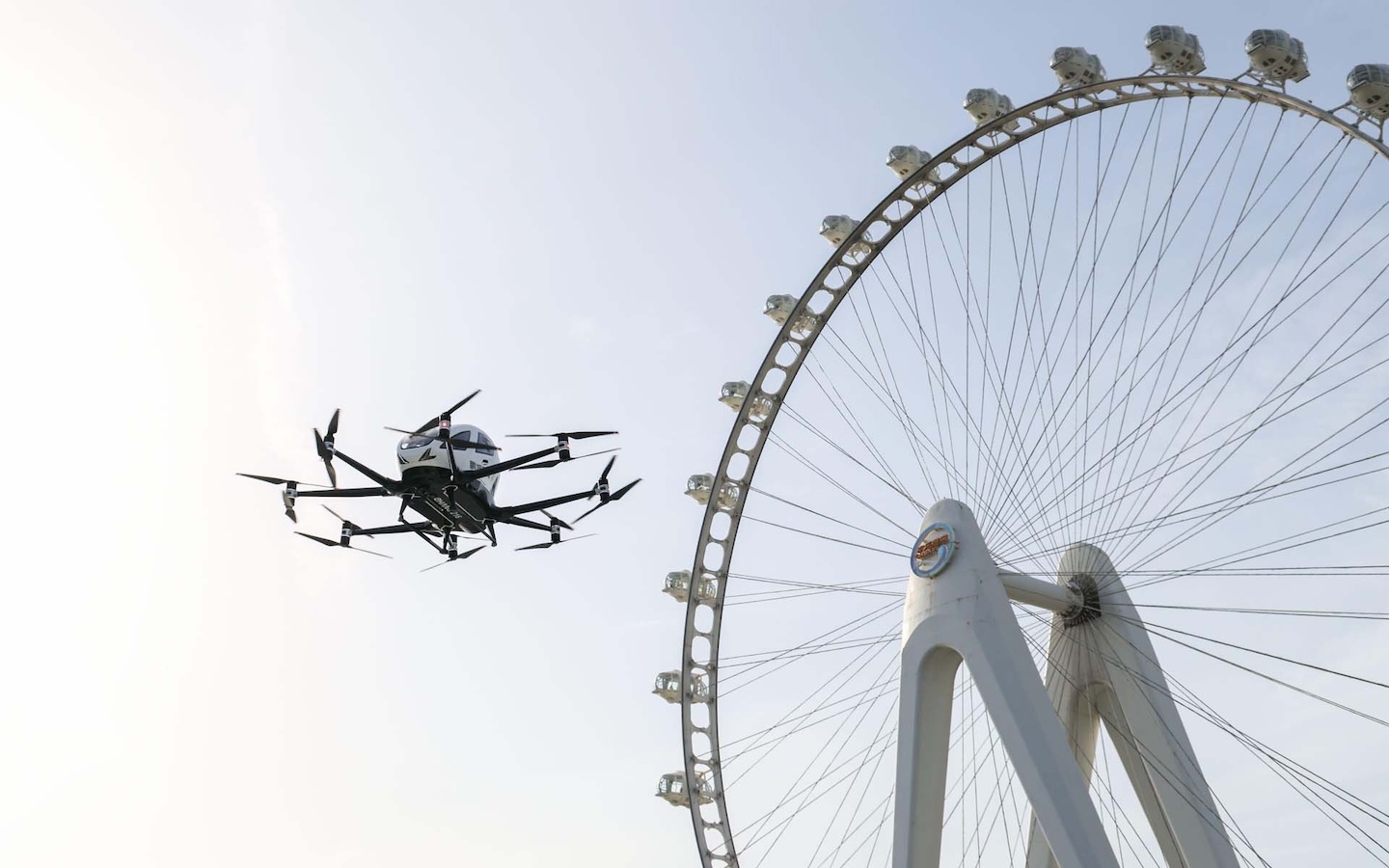
Taking an “air taxi” across the Guangdong-Hong Kong-Macao Greater Bay Area or using drones for urban goods delivery may soon become an everyday option for people and businesses alike. The low-altitude economy is widely seen as “taking off” across the region, where it is being positioned as a strategic emerging cluster at the intersection of technological innovation and economic diversification.
The term refers to economic activities conducted in airspace below 1,000 metres. It marks a shift from the isolated use of drone technologies towards a broader economic system that leverages low-altitude airspace for applications ranging from logistics and mobility to public services.
A report published last year by the international professional services firm Arup, “Planning for a Low-Altitude Economy in the Greater Bay Area”, described the region’s “interconnected cities, technological capabilities, and policy momentum” as making it “an ideal environment to pilot and scale low-altitude economy systems”. The region’s diversity in urban form and governance – with three different jurisdictions –, the report added, “provides a valuable testing ground for cross-boundary coordination and innovation.”
Guangdong Province already occupies a central position in China’s low-altitude landscape. According to data from the Guangdong Provincial Development and Reform Commission, the province hosted more than 15,000 low-altitude industry chain enterprises last year, accounting for about 30 percent of the national total. In 2024, Guangdong produced 6.94 million civilian drones, representing 95 percent of China’s consumer-grade market and 54 percent of its industrial-grade segment.
Hong Kong is also moving proactively. Following the launch of a regulatory sandbox scheme, the Hong Kong Special Administrative Region (HKSAR) Government is expected to issue its action plan on developing the low-altitude economy later this year. The aim is to position Hong Kong as a hub for low-altitude innovation and applications through institutional reform and technological advancement, according to comments made in January by Maisie Chan Kit-ling, the HKSAR’s Commissioner for the Development of the Greater Bay Area.
Macao’s role

China’s forthcoming 15th Five-Year Plan, due to be submitted to the National People’s Congress in March, is expected to identify the low-altitude economy as one of the country’s strategic emerging industrial clusters. Observers say the Greater Bay Area, with its strong industrial base and economic dynamism, is not only fertile ground for sectoral growth but also well placed to act as a global pioneer and pilot zone.
“The low-altitude economy is a national strategic industry and a new engine for Greater Bay Area integration,” said Tai Kin Ip, Secretary for Economy and Finance of the Macao Special Administrative Region (MSAR) Government, speaking last December at the 2025 Conference on High-Quality Development of Low-Altitude Economy in the Guangdong-Hong Kong-Macao Greater Bay Area. He added that Macao would strengthen cooperation with neighbouring cities to contribute to the sector’s development. At the same event, Macao signed agreements on cross-boundary low-altitude cooperation with Zhuhai and Guangzhou, respectively.
The MSAR’s comparative advantage, analysts suggest, lies more in its institutional capacity and less in its industrial scale. Hon Chi Tin, a professor at the Institute of Systems Engineering at the Macau University of Science and Technology, argues that the city’s strength is firmly grounded in its ability to support standard-setting and scenario-based demonstrations that can facilitate smoother cross-jurisdictional operations across Guangdong, Hong Kong and Macao.
“The most appropriate positioning for Macao in the Greater Bay Area’s low-altitude economy is not about how large the industry is or how many flights it operates, but about serving as a critical node for scenario-based demonstrations and the promotion of international standards,” Prof. Hon told Macao Magazine. As the sector moves from concept to implementation, he said, jurisdictions that can first establish practical applications that are regulatable, assessable and replicable will gain an advantage in shaping rules and standards.
Low-altitude on the rise
Prof. Hon attributes the rapid rise of the low-altitude economy in the Greater Bay Area to a convergence of factors. National policy has incorporated it into efforts to cultivate new productive forces and strategic industries, while cities across the region are advancing pilot projects across multiple scenarios, creating a relatively comprehensive testing environment.
“The development of the low-altitude economy depends on the joint functioning of several core elements, including airspace access, aircraft, take-off and landing facilities, supporting infrastructure, safety and compliance frameworks, and real-world demand,” he said. “These elements are highly interdependent, and none of them can be absent.”
Ultimately, however, Prof. Hon argues that airspace governance remains the decisive factor, as only by clarifying airspace use and management rules can other elements be effectively mobilised and translated into operational, regulatable models. From this perspective, Macao’s relatively constrained airspace and compact urban scale make it better suited to a “rules first, scenarios second” approach, he suggests. By validating safety and compliance under controlled conditions, Prof. Hon believes the city can build institutional experience that will be essential for future cross-boundary commercial operations.
An evolving economy
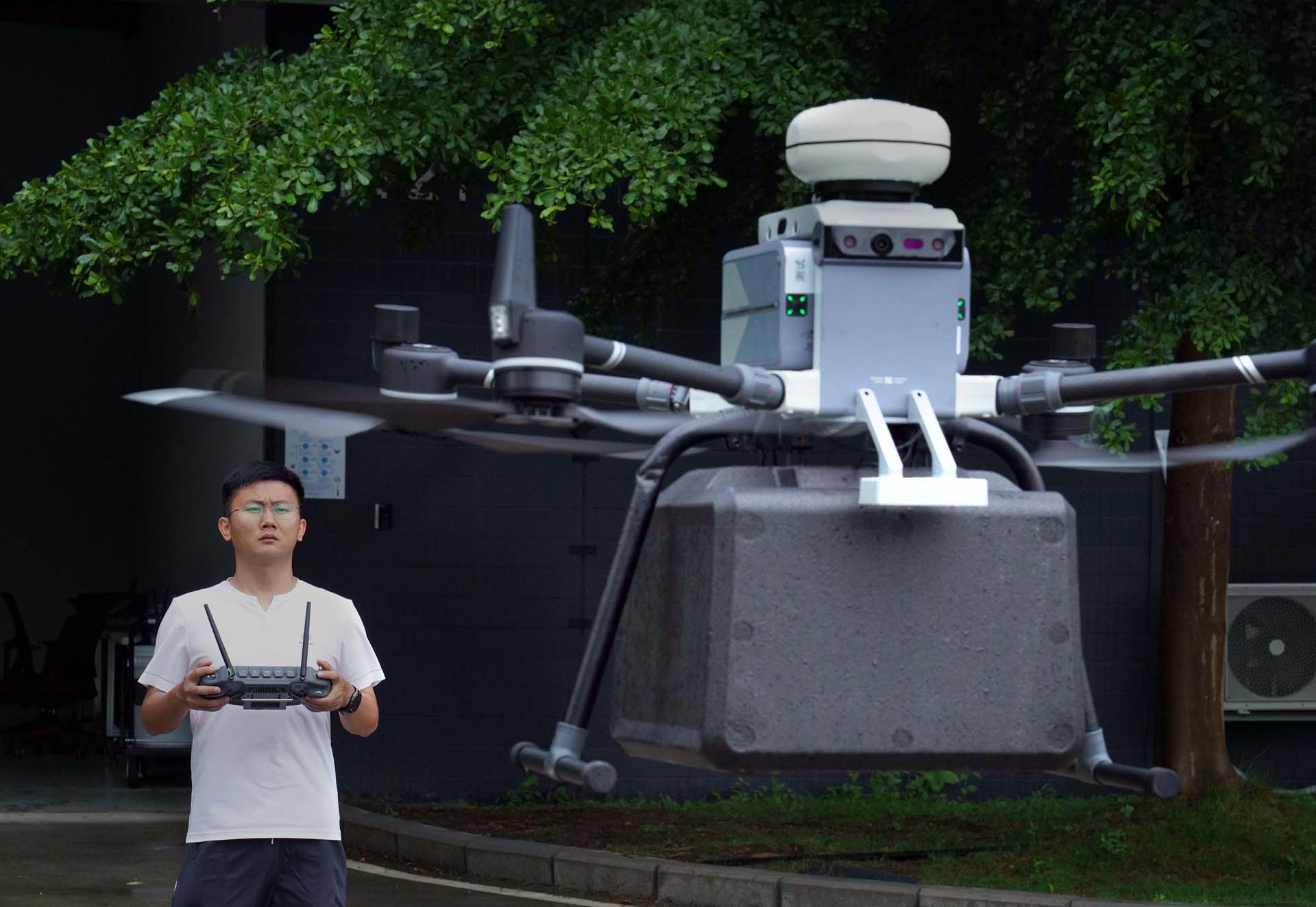
Momentum accelerated in 2024, after the low-altitude economy was included for the first time in China’s annual government work report by the State Council. Several cities quickly rolled out pilot schemes. Shenzhen launched what was described at the time as the world’s first cross-sea, cross-city electric vertical take-off and landing (eVTOL) route, linking Shenzhen and Zhuhai, with a demonstration flight in February 2024 cutting a two-hour road journey to just 20 minutes.
Guangzhou Baiyun International Airport and Zhuhai Jinwan Airport have since established low-altitude flight service stations, while more than 30 low-altitude routes across the Greater Bay Area had entered testing by the end of last year, covering passenger transport, cargo delivery and emergency rescue.
The development of the low-altitude economy in Macao faces a more complex set of circumstances. The city has a land area of about 33 square kilometres, with limited usable airspace. Its airspace also overlaps significantly with flight zones associated to Zhuhai’s airport and height-restricted zones linked to the Hong Kong-Zhuhai-Macau Bridge. Pursuing large-scale route expansion or flight volume is widely seen by observers as unrealistic.
Chao Ka Chon, a member of the Macao Legislative Assembly and a technology entrepreneur, told Macao Magazine that while many Chinese mainland cities have entered pilot operation phases, Macao is currently at a “preliminary planning” stage, with progress needing to balance safety and feasibility.
He noted that the Macao SAR Government has established a dedicated low-altitude economy task force, coordinated by the Economic and Technological Development Bureau, which held its first meeting last August to discuss strategy, application scenarios and regulatory frameworks. Even so, Mr Chao acknowledges practical limitations, including a high concentration of heritage buildings, with some areas designated as no-fly zones. Dense high-rise developments can create wind tunnel effects, while extensive glass façades may interfere with Global Positioning System (GPS) signals, he notes.
In addition, shipping channels, as well as cross-sea bridge corridors, are all designated no-fly areas. Taipa and Coloane also contain helicopter flight paths, further compressing Macao’s usable airspace for drones and other low-altitude aircraft. Areas appropriate for the development of take-off and landing sites, as well as supporting communications infrastructure, are also limited. “In dense urban areas, it may not be feasible to set up multiple launch points, and these issues still require further discussion,” he said.
Rather than pursuing scale-driven growth, Mr Chao argues that Macao should focus on regulatory alignment and application demonstration. Under the “One Country, Two Systems” framework, he suggests the city could help pilot mutual recognition mechanisms for low-altitude economy standards covering data flows, insurance liability and operator qualifications within the Greater Bay Area. On the application side, potential niches include heritage tourism, filming, infrastructure inspection, and drone-based emergency rescue, developed in coordination with Hengqin’s industrial resources. This could lead to a collaborative model of “Macao-based research and development, Hengqin-based testing”, Mr Chao said.
Cross-boundary platforms
As China’s low-altitude economy shifts from experimentation to commercial operation, companies are increasingly focused on whether regulatory rules can be translated into workable, scalable business frameworks. Guangdong Low Altitude Economy Development Co., Ltd. has emerged as a key builder and operator of public low-altitude infrastructure in the province.
The sector’s real challenge, according to board director Lin Yutian, is whether system capability, data integration and public platforms can be implemented effectively, he told Macao Magazine.
Demand in the Greater Bay Area, he said, currently clusters around three areas: low-altitude logistics; public services such as emergency rescue and power line inspection; and low-altitude tourism and services including sightseeing flights and drone performances. To support these uses, Guangdong’s government drone management platform for public-sector applications went online last December, enabling unified, network-based flight management through measures such as airspace grid allocation and centralised demand coordination.
Cross-boundary operations, however, remain complex. “What companies care about most is not a single technical issue,” Mr Lin said, “but a systemic alignment of airspace, legal frameworks and regulatory regimes.” Differences between Guangdong, Hong Kong and Macao in areas such as airspace management, airworthiness certification (which grants authorisation to operate an aircraft in flight), pilot licensing and liability frameworks mean that progress must be gradual and coordinated at a higher policy level, he said.
Here, Macao’s institutional environment is seen as carrying particular weight. Mr Lin said the city is not only home to high-value potential application scenarios but also enjoys advantages in promoting cross-boundary communication and regulatory alignment. He added that the MSAR’s universities and research institutions are increasingly involved in international standards discussions, including initiatives led by the Institute of Electrical and Electronics Engineers – commonly known as IEEE – on low-altitude economy, which address flight safety, system interfaces and operational management.
Commercial rollout
Among the early movers in passenger-grade unmanned aviation is EHang Intelligent Equipment, a Guangzhou-based autonomous aviation firm listed on Nasdaq. The company says it is now technically and operationally ready to begin commercial services.
“The company is ready to launch commercial operations and plans to progressively roll out eVTOL flight services through a reservation system in the short term,” said Wu Yachen, EHang’s vice-president, in an interview with Macao Magazine.
She stressed that commercialisation would be phased, following a “safety first, risk-progressive” approach. The company has already deployed its EH216-S aircraft and supporting system in real operating environments, accumulating hours of flight and operational experience.
Cities such as Macao, Ms Wu argued, are well suited to eVTOL applications due to their limited land area, high population density and tourism-led economies. With its compact size and vertical take-off and landing capability, EHang’s EH216-S aircraft could be used for sightseeing or as an urban air taxi, offering new mobility and tourism experiences, she said.
Looking ahead, Ms Wu said large-scale deployment across the Greater Bay Area would depend on clearer regulatory frameworks and technical standards, coordinated infrastructure development and greater public acceptance. Macao’s ability to establish a demonstration model that is both replicable and internationally compatible, she added, will be crucial in shaping the city’s pace and prospects of commercialisation in the low-altitude economy.