
After decades of writing, award-winning Chinese mainland author Bi Feiyu says he has reached a deeper understanding of what it truly means to craft a novel.
“We all know that a novel creates a world of its own, but in my case, my life and my literature have become inseparable,” Mr Bi told Macao Magazine in an interview. “Because I write in Chinese, my existence has lived within that language: I feel through it, I express myself through it, and it has shaped my world.”
He elaborates that fiction is not a mirror of reality, but an expression of values and aesthetics closely linked to the author. “Strictly speaking, fiction has no direct connection with real life – it is imagined, not reality. Yet when we write, our novels are guided by a system of values. Every writer works within such a framework, and alongside it there is also an aesthetic dimension. These values and aesthetic pleasures are not imaginary; they are essential to life itself.”
Writing, he says, has shaped his very identity. “I now possess a constant set of values and a lasting sense of aesthetic taste, and together they have made me who I am today. Through decades of work, I have become this particular version of myself, rather than someone else. Writing and I influence each other, and that mutual influence is what makes me happiest.”
A life of award-winning literature
Born in 1964 in Xinghua, a county-level city in Jiangsu Province, Mr Bi – whose first name, Feiyu, means “one who flies across the universe” – grew up in a household steeped in words. His parents taught Chinese language, and his sisters also pursued degrees in education.
“I lived in such a family,” he recalled, “so becoming a writer was inevitable.” By the mid‑1980s, he was already publishing short stories, launching a career that has spanned nearly four decades.
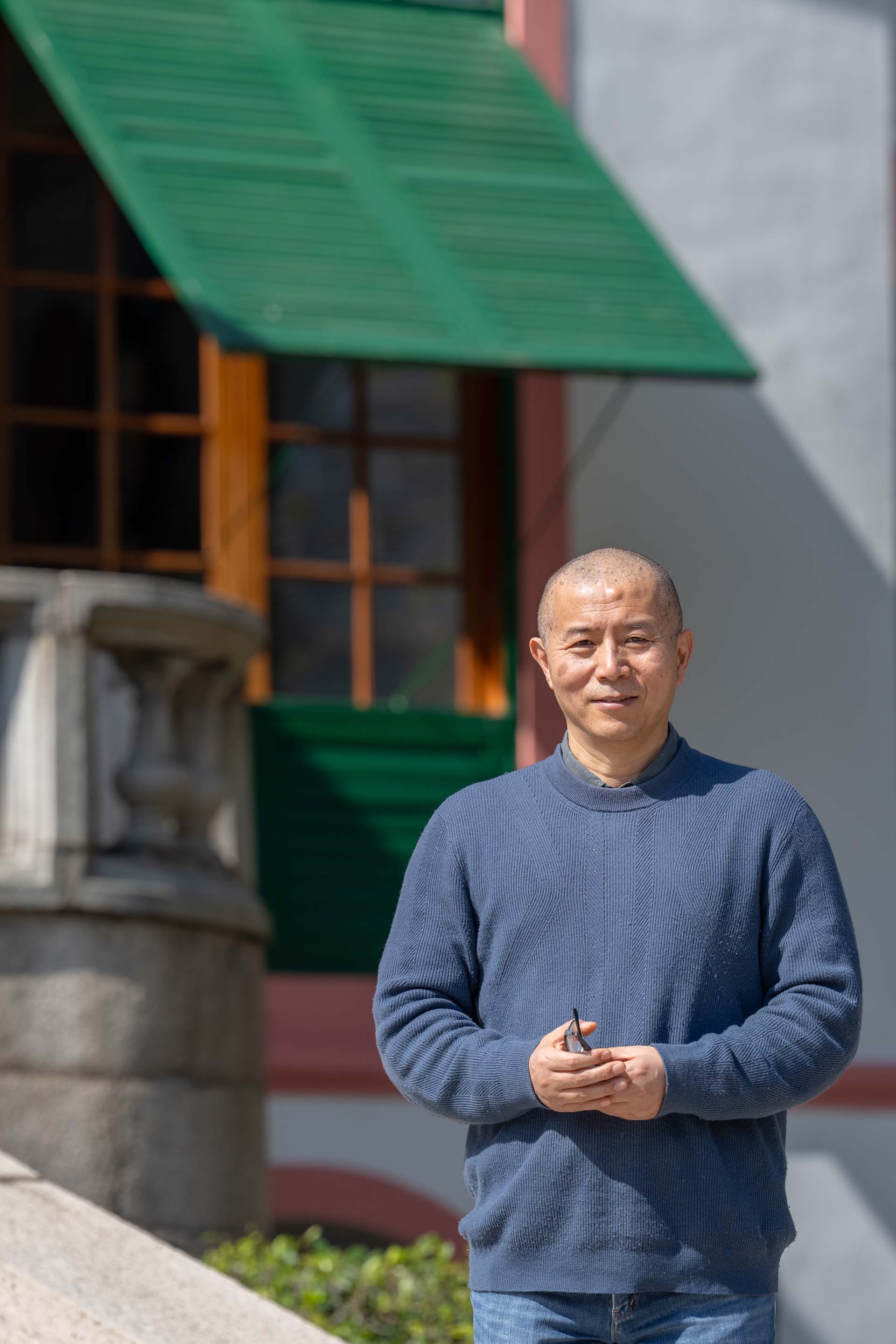
Now based in Nanjing, Mr Bi worked as a literary editor and today teaches creative writing at Nanjing University. He is celebrated for his nuanced portrayals of women and a storytelling style that blends everyday language with settings drawn from small towns and familiar cityscapes.
Domestically, Mr Bi has won the Lu Xun Literature Prize twice: in 1998 for his short story “The Lactating Woman”, and again in 2003 for his novel “Three Sisters”. In 2011, “Massage”, exploring the lives of blind massage therapists and the intimate dynamics of their community, earned him the prestigious Mao Dun Literature Prize, China’s highest national literary award.
Internationally, his works have been translated into more than 20 languages. “The Moon Opera”, translated into English by Howard Goldblatt, one of the foremost translators of modern and contemporary Chinese literature, and Sylvia Li-chun Lin, was longlisted for the 2008 Independent Foreign Fiction Prize, a literary award in the United Kingdom. The novel follows Xiao Yanqiu, a former Peking opera performer who, decades later, is offered the chance to return to the stage in her signature role, but her growing obsession with the character gradually blurs the line between performance and reality.
With the translation of “Three Sisters” – also by Mr Goldblatt and Ms Lin – Mr Bi won the 2010 Man Asian Literary Prize. That is arguably his most recognised work internationally: the story of three women from rural China striving to build a life amid the turbulence and uncertainty of the 1970s and 1980s.
His novels have also inspired cinema: “Blind Massage”, directed by Lou Ye, from the Chinese mainland, won best feature film and best adapted screenplay at the 2014 edition of the prestigious Golden Horse Awards. Mr Bi co-wrote the screenplay for the 1995 film “Shanghai Triad”, which was directed by the acclaimed Chinese mainland filmmaker Zhang Yimou.
He also enjoys a following in France, where in 2017 the Ministry of Culture awarded him the Ordre des Arts et des Lettres (Order of Arts and Letters). These accolades underscore his status as one of China’s top contemporary novelists.
A work of solitude
Pragmatic about recognition, Mr Bi notes: “Prizes make a writer happy for a moment, but then the moment passes. They don’t change your life. Of course they are important; they bring joy, but once the ceremony is over, it’s finished. No one carries a literary prize in their heart forever.”
For him, the true reward lies in the companionship of his own works. “I treat all of my books with great care. Readers respond differently; some books are more popular, some less so. A few have won prizes, others have not; some have sold well, others have struggled,” he said. “That is the readers’ choice. For me, I value them all equally, because when I was writing each one, they accompanied me through a period of my life. Each book was part of my journey, and I cannot say I prefer one over another.”
Solitude, he believes, is a defining trait of a writer’s life. “I was born a solitary person, and I chose writing,” he reflected. “A writer must learn the skill of living with oneself. Many people do not understand this, nor do they know how to be at ease in their own company. They call it loneliness. Yet if one has the ability to live with oneself, solitude becomes something entirely different – it is deeply enjoyable.”
Writing itself, he adds, has become a lifelong companion. “Literature is a good friend invisible to others, but visible to me.”
The art of slow
In an era dominated by rapid social media and fleeting attention, Mr Bi champions what he calls ‘slow reading’. “In today’s fast-paced world, speed is everywhere. Short videos have changed habits, and quick reading is often necessary to absorb information efficiently. But we must remember that life is not about speed. Some works can be read quickly, but when you want to savour them, the process should be slow.”
He stresses that slow reading enriches maturity. “In your teens and twenties, the ability to read quickly is a good thing; you gain more knowledge than others. But if, by the age of 40, you have not learned to read slowly, to think as you read, to taste the language, then you are not truly fortunate.”
The metaphor is simple, he adds. “Speed is never the goal. It is the same with cooking: we don’t cook to be fast; we cook to make food delicious and nourishing. Occasionally, when busy, you may rush, but if you eat fast food every day, that is a problem.”
His objection to artificial intelligence in writing reflects this philosophy. Mr Bi has publicly said he views the craft as a means to experience and express the world through words, an enjoyment he values above any improvement AI could bring to his work.
Choosing literature
Mr Bi is candid about challenges facing young authors today. “Forty years ago, the environment was better. We had more time to write. Today, life pressures are greater, and writing demands enormous time. If too much time is spent on writing, life itself may suffer.”
Yet he remains hopeful. “No matter how difficult life becomes, there will always be people who choose literature. I firmly believe that.”
He acknowledges that Chinese literature has achieved greater international recognition, with more translations and a wider readership than 30 years ago. He has also contributed on a more academic level: his 2017 collection “Literary Lectures” – a series of talks on Chinese literature delivered at leading Chinese universities – was published in English in 2022.
Nonetheless, Mr Bi remains grounded. “We cannot say that Chinese literature holds a high position yet. English, French, German, Italian, Spanish and Portuguese writers still dominate. Since not many foreigners can read Chinese, Chinese literature occupies only a small proportion globally, which does not match the size of our country. For Chinese literature to gain a stronger place, it will take time, and better works.”
Patience, he concludes, is essential. “If we write long enough, and well enough, the future of Chinese literature will certainly improve.”
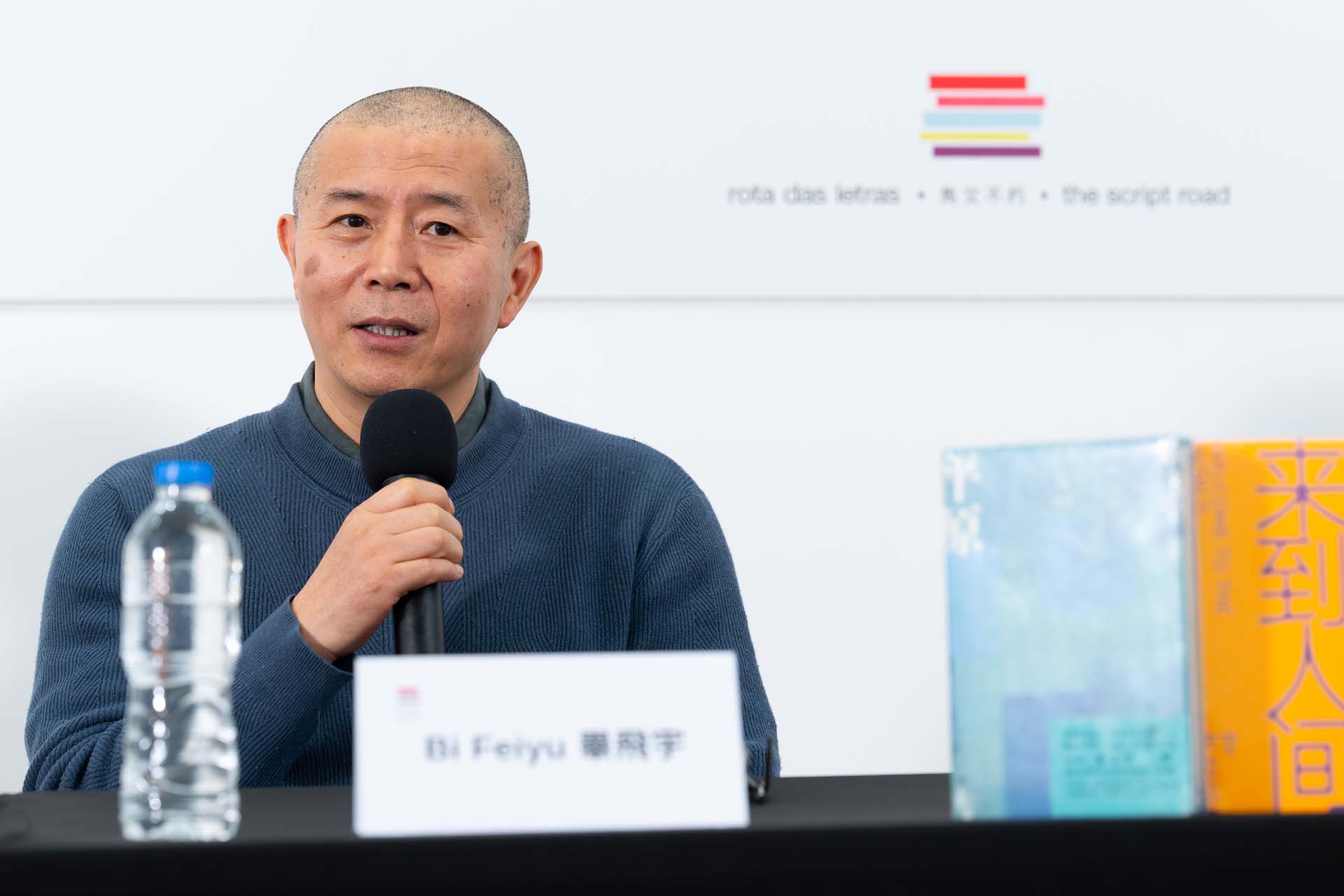
| ENCOUNTERS WITH MACAO Bi Feiyu has visited Macao many times, often invited by friends and universities. “The city is very appealing when it comes to cuisine,” he told Macao Magazine, though he admitted Macao is unlikely to feature in his near-term literary projects. “A responsible writer cannot write about a place without deep understanding of its life and culture.” In March, he returned as a guest speaker at the 15th edition of the Macau Literary Festival – The Script Road. “[I came] to meet more Macao readers, to make new friends,” he said. He is optimistic about Macao’s literary future. “This is a place of rich cultural exchange and a slower pace of life. As more people from the Chinese mainland arrive, they bring not only language but also culture. That exchange will strengthen Macao’s literary future. I believe that.” Mr Bi recalled meeting young local writers during a previous visit. “I spent time with them discussing writing together. There were three or four who impressed me greatly. What they need most is time and patience.” Comparing Macao’s younger voices to those from the Chinese mainland, he notes: “People in Macao have a calmer cultural mindset. They are more composed, quieter. Compared with places like Shanghai, Hong Kong, Beijing, Tokyo or London, the pace of life in Macao feels slower, more settled. It’s not so competitive, not so exhausting.” For Mr Bi, Macao’s potential lies in its slower rhythms and status as a city of exchange. “Many communities from Europe, Southeast Asia and elsewhere have lived here. The richer the exchange, the greater the possibility for literature to flourish.” |