
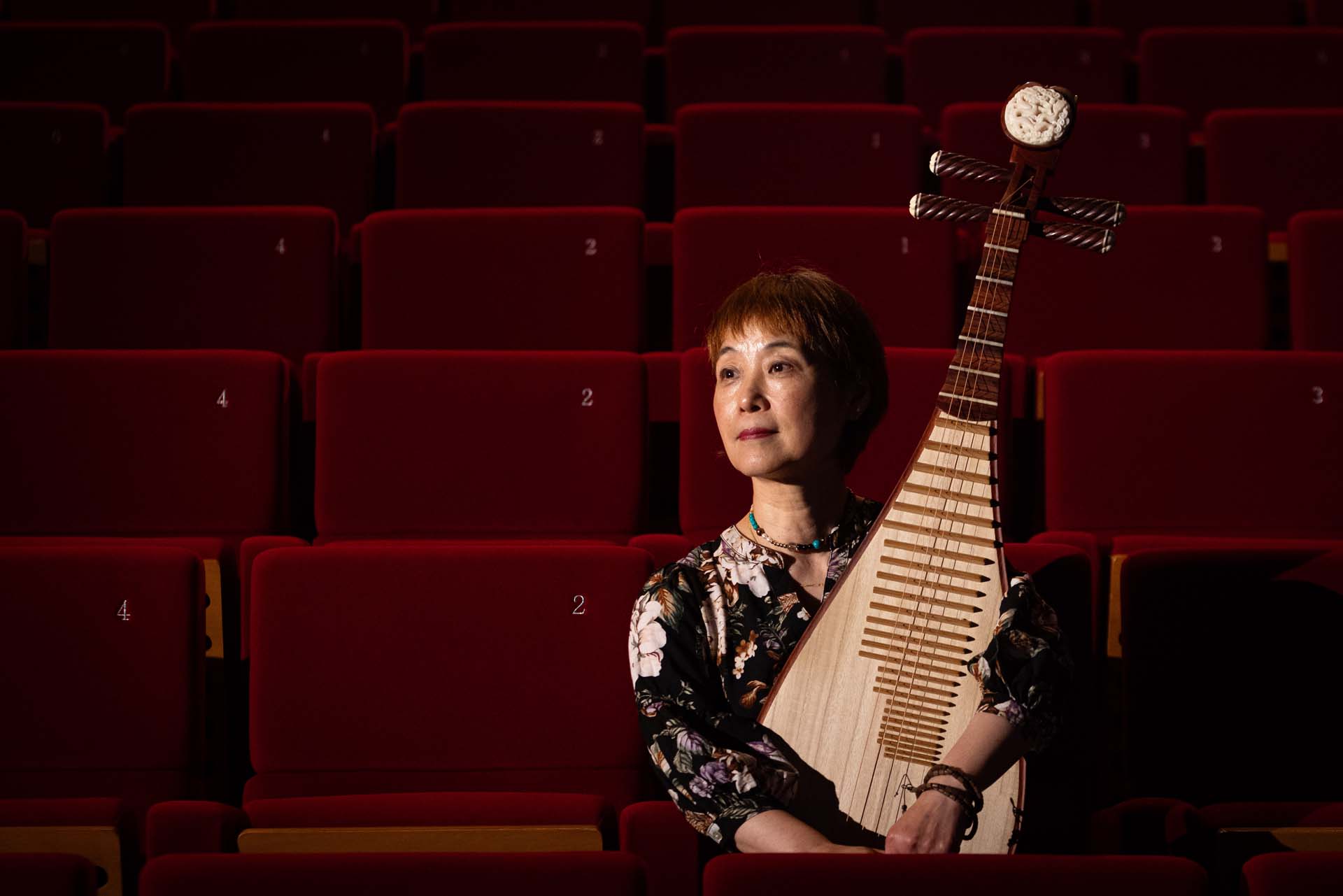
Born in Hangzhou in 1963, Wu Man discovered the pipa almost by chance.
“My parents weren’t musicians,” she said in a recent interview with Macao Magazine. “They were music lovers. My father was an artist. They thought the pipa looked very elegant and beautiful for a girl to play. That’s how I started.”
At the age of just 13, she was accepted into Beijing’s Central Conservatory of Music, where she was soon hailed as a prodigy. She would then go on to become the first musician to receive a master’s degree in pipa from the prestigious conservatory – a milestone that reflected both her extraordinary talent and the instrument’s growing academic recognition.
By the late 1980s, she had already established herself as one of China’s leading young performers of traditional music.
At the height of that early success, however, she made an unexpected move.
She decided to further pursue music in the United States. When she arrived in 1990, she entered a world where almost no one knew either her or the instrument she had devoted her life to mastering.
“It was curiosity,” she said. “I was looking for opportunities. I wanted to learn more.”
The reality proved challenging.
“The first few years were definitely difficult,” Ms Wu recalled. “Nobody knew Chinese culture. Everyone knew Bruce Lee, Jackie Chan and martial arts, but very few people knew what the pipa was.”
This move would become the first step in a career that would make her one of the instrument’s most influential ambassadors.
Gaining global perspectives
More than 35 years later, those uncertainties have given way to an international career that has fundamentally reshaped perceptions of the instrument. Yet Ms Wu rejects the idea that her collaborations were ever intended to modernise Chinese music.
“I don’t see differences,” she said. “Whether I play jazz, Central Asian music, traditional Chinese music or contemporary music, it’s all music. I need to understand that musical language and then find a way for the pipa to interpret it.”
The result is a career that refuses to be constrained by genre. Asked whether she considers herself a traditional Chinese musician, a contemporary artist or a world musician, she dismisses every label.
“I don’t have any label. To me, I am a musician.”
Working alongside musicians from different traditions has not diluted Ms Wu’s understanding of Chinese music. Instead, she believes it has deepened it.
“I play traditional pieces very differently from 20 or 30 years ago,” she said. “Everything makes more sense to me.”
She points to an unexpected example. After collaborating with musicians from Azerbaijan, she recognised striking similarities between their vocal traditions and music from western China.
“The intonation, the ornamentation, the little vibrato – it was very much like Chinese music. I learned from them... Now I understand Chinese music much better.”
Living abroad also gave her a fresh perspective on her own musical heritage. “Sometimes when you leave somewhere and then look back, everything becomes very clear.”
Performing in Macao
That philosophy was reflected in the programme she curated for her recent appearance with the Macao Chinese Orchestra in June, where she performed not only as a musician but also served as artistic director. The concert brought together well-known Chinese classical music, contemporary work by Chinese composers living overseas and music inspired by Central Asian traditions.
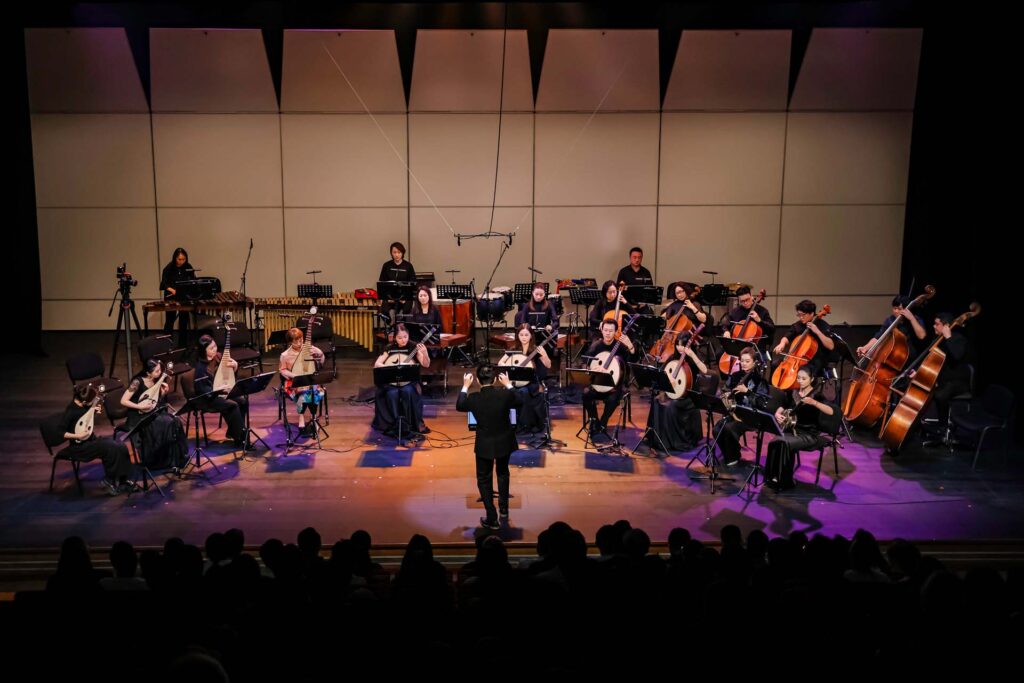
Despite having performed previously in Macao, this was Ms Wu’s debut with the Macao Chinese Orquestra.
“I’ve known the Macao Chinese Orchestra for a long time,” she said. “They’re amazing. They’re exactly like Macao. They keep tradition but they’re also creative and innovative. They’re very open-minded and bring different things together.”
During a rehearsal break in Macao, she introduced the pipa that she had specifically chosen for this journey.
Some pipas, she says, have a darker, warmer tone; others are brighter and more penetrating. The pipa selected for the Macao performance was made in Beijing and, according to Ms Wu, is better suited to performing with an orchestra. It is one of five she owns, each designed to meet to the different demands of the repertoire.
“The pipa is a four-stringed lute and is about 2,000 years old,” she said. “It was introduced from Central Asia to China, and has now become very much a Chinese instrument.”
Over the past three decades, Ms Wu has carried the pear-shaped instrument from China to concert halls in New York, London, Paris and beyond, introducing the pipa to audiences who, through her work, now encounter it in symphony orchestras, chamber music festivals and contemporary music premieres.
“It has a unique sound,” she said. “It can be lyrical, dramatic, percussive, colourful or meditative.”
Pipa pioneer
Widely regarded as the world’s foremost pipa player, Ms Wu has built a career that reads like a catalogue of firsts.
She has premiered hundreds of new works and performed with leading orchestras, from the New York Philharmonic to the Chicago Symphony Orchestra. She has collaborated with the internationally renowned Kronos Quartet for more than three decades and played a pivotal role in the Grammy Award-winning Silkroad Ensemble’s exploration of musical exchange across Asia, the Middle East and beyond.
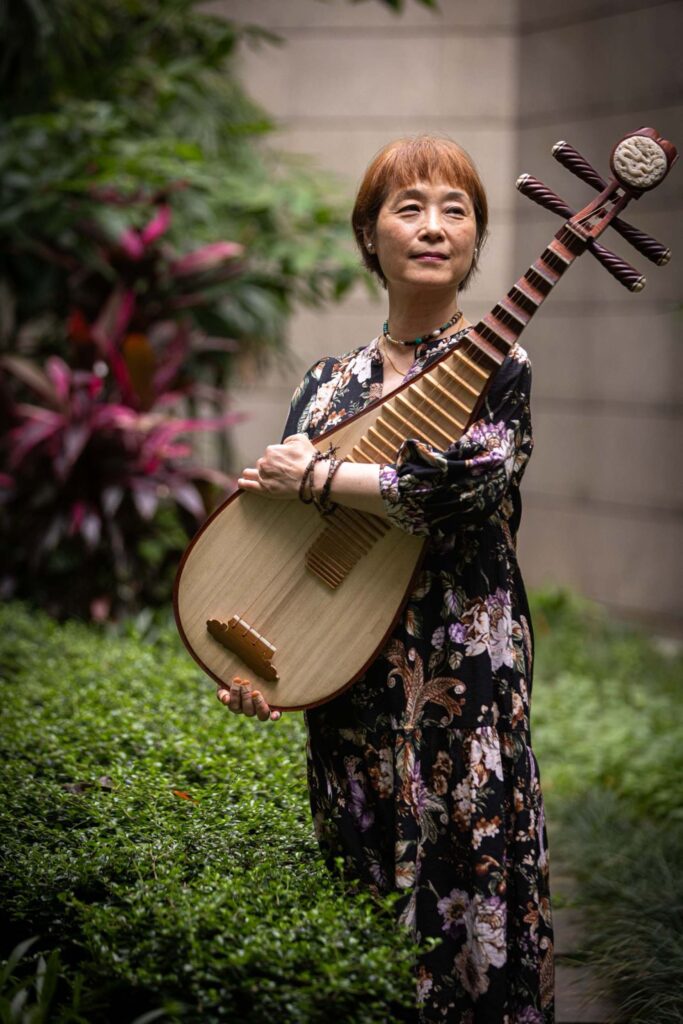
Recognition has followed. In 2013, she became the first performer of a non-Western instrument to be named “Instrumentalist of the Year” by Musical America. A decade later, she received the National Heritage Fellowship from the U.S. National Endowment for the Arts – one of the country’s highest honours for folk and traditional arts.
She also became the first artist from China to perform at a White House state dinner, appearing at the 1999 banquet hosted by President Bill Clinton in honour of Chinese Premier Zhu Rongji.
Then in 2021, she went on to earn an honorary Doctorate of Music from the New England Conservatory in Boston.
Her discography now spans nearly 50 albums, including the 2024 “Music from the Dunhuang Caves”, which brings to life 25 ancient pipa scores discovered in the Mogao caves in Gansu province.
Driven by discovery
In recent years, Ms Wu has devoted increasing attention to what she calls her “Return to the East” initiatives, travelling through remote regions of China to document endangered musical traditions and introduce rural musicians to international audiences. The work inspired the documentary “Discovering a Musical Heartland: Wu Man’s Return to China” and international tours featuring performers who had rarely, if ever, appeared outside their home regions.
Alongside her touring career, she continues to teach as a visiting professor at Beijing’s Central Conservatory of Music and as a distinguished professor at conservatories in Zhejiang and Xi’an, while giving masterclasses across China.
“I really want to explore educational initiatives,” she said. “How can I share my experience with the younger generation?”
Although she acknowledges that many young people in China are drawn to Western instruments such as the piano, she believes traditional instruments continue to attract strong interest. “There are still many young people learning traditional instruments.”
Her advice has little to do with competitions or career planning. “First of all, you have to love music.”
Then comes the principle that has guided her own life. “Be open-minded. Listen to all kinds of music. Don’t hesitate. Step outside. You never know what will inspire you.”
That spirit of curiosity continues to shape her career. Her 2026-2027 season includes a creative residency programme at Brown and Harvard universities, performances with Kronos Quartet and international touring with the Aga Khan Music Initiative. She will also perform alongside Yo-Yo Ma and Rhiannon Giddens at the Silkroad Ensemble’s 25th anniversary celebrations at Carnegie Hall and take to the stage at the world premiere of a new pipa concerto by U.S. composer Mason Bates in Los Angeles. In China, she has an artist residency with the Shanghai Symphony Orchestra and orchestral performances across the country.
Ms Wu laughs when asked why she continues to maintain such a demanding schedule.
“I really love music,” she said. “I want to meet people and learn something that inspires me.”
Even her listening habits reflect that restless curiosity. Her playlists range from Central Asian recordings and Chinese opera to contemporary chart music.
“I do listen to K-pop,” she admitted with a grin. “Sometimes it’s very inspiring.”