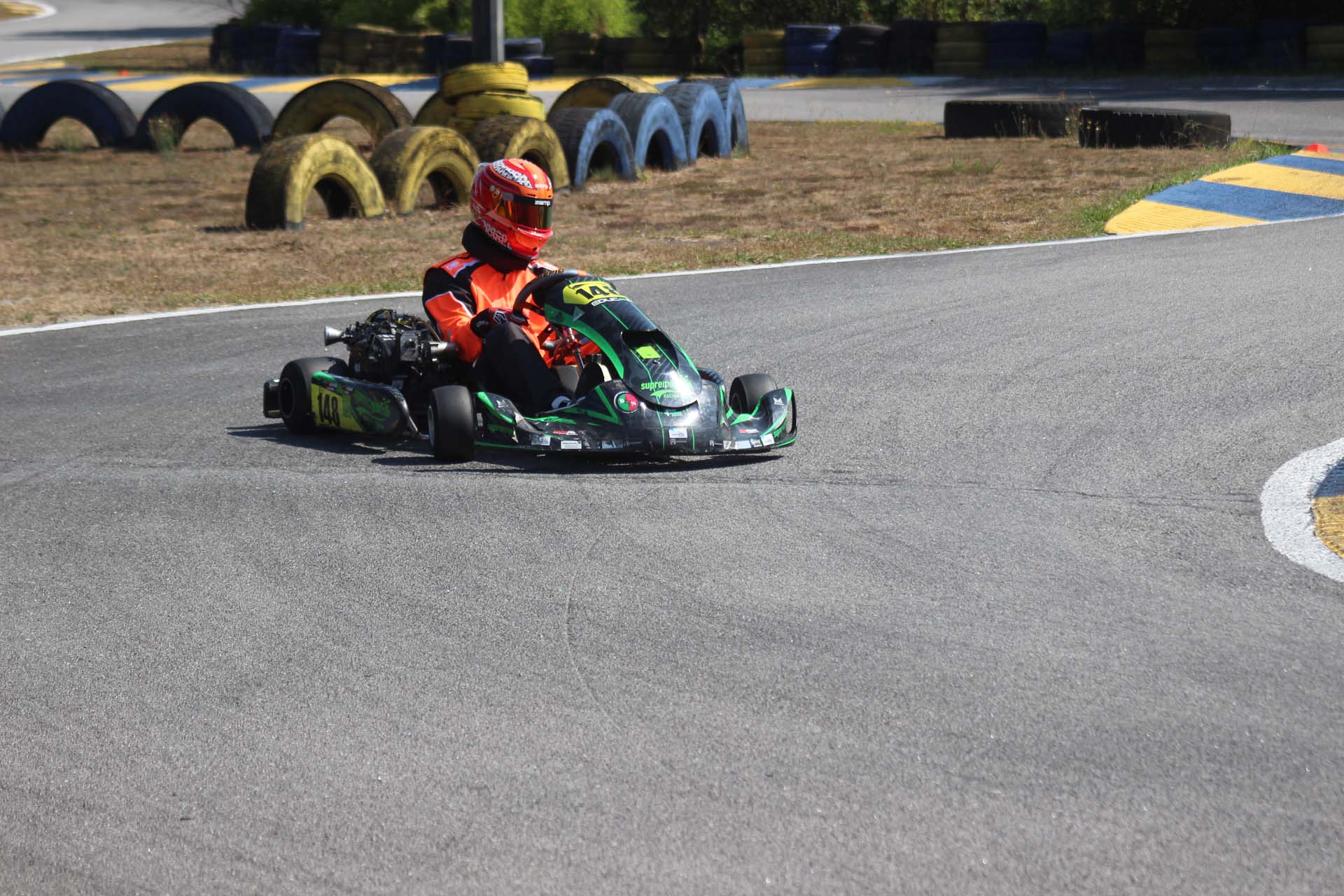
Born in Macao to a Portuguese family, 18-year-old Pedro Durães is testing himself on a major international stage. Like other young Macao drivers venturing overseas to pursue motorsport careers, he moved to northern Portugal last year to continue his secondary education and chase his racing dreams. In a nod to his family roots, he launched his European racing career in Fafe, his parents’ hometown.
After securing second- and third-place podium finishes in local endurance races at Fafe, Mr Durães earned a guest invitation to a round of the Iberian Karting Championship (IKC) at Portugal’s Braga International Circuit. Facing far more experienced rivals, the young talent kept a mature “cool head” and finished an impressive third. That breakthrough performance opened the door for him to contest the entire 2026 season.
He quickly made the most of the opportunity. Competing in the Proto2 420 category – with a team that is a tie-up between LK Motorsports Racing and Supremo Gosto Racing – the Macao-born driver established himself as a frontrunner and sealed the crown during the round at the Castelo Branco circuit – with two rounds still left to spare.
“It has been very good, mainly because this is my first experience in a competition at this level,” he told Macao Magazine, adding that “there is still a lot to learn”.
Winning a championship of this scale is no small feat. The highly competitive IKC features more than 60 drivers and 30 teams from Portugal, Spain and France who compete across three categories. The championship consists of six races followed by the EPIC Cup, expected to take place in early 2027. But while Mr Durães may be making his mark in karting now, his ultimate ambitions stretch much further – and this championship is just the beginning.
Coaching for the next level
Having already completed several tests in the Proto1 460 category, he is now preparing for the next step: joining a team coaching programme designed to “take him beyond what he is capable of today”. The objective is to move from four-stroke to two-stroke karts and, from there, “keep moving up through the levels,” according to the team.
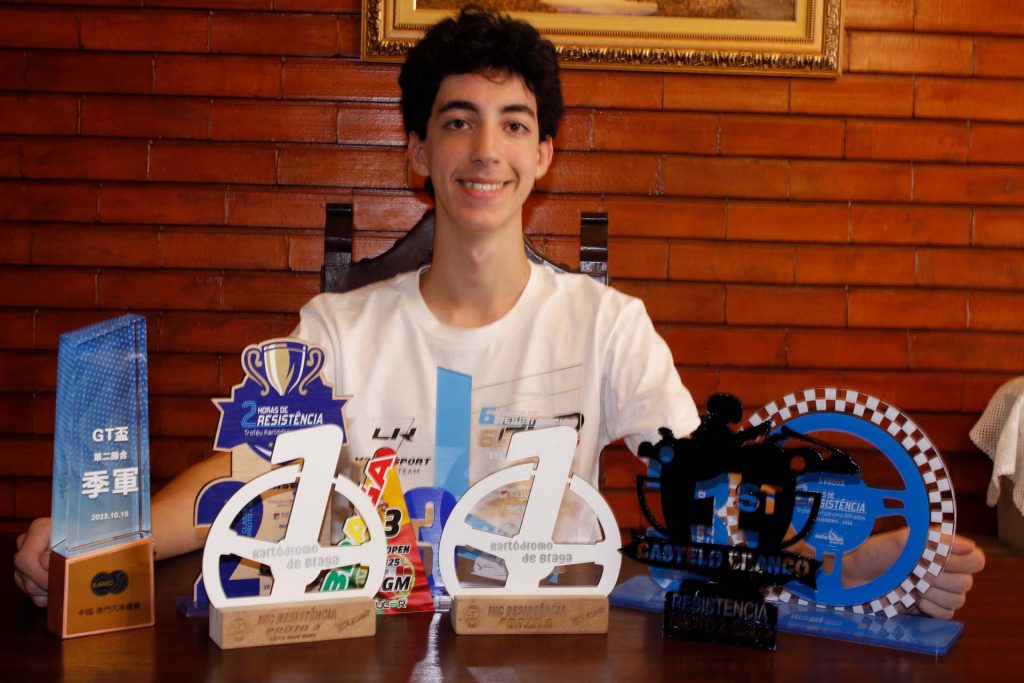
The first move is to compete in the European karting championship with the ultimate goal of transitioning into sports cars or single-seaters. To do so, Mr Durães needs to secure sponsorship, as costs rise considerably at the higher levels of motorsport, he says.
He has always dreamed of competing in elite series like the GT World Challenge (GTWC), European Le Mans Series, IMSA and World Endurance Championship. “Ever since I was little, I loved watching drivers like Vanthoor, Buemi and Kobayashi,” he says.
Of those ambitions, the GTWC holds particular appeal because it could one day fulfil a childhood dream of racing on the streets where he grew up.
“Ever since I was a child, it has been my dream to race in the Macau Grand Prix and leave my mark on one of the most challenging street circuits in the world: narrow, steeped in tradition and a place where champions are made,” he highlights.
Building a ‘solid foundation’
Mr Durães’ experience pursuing motorsport in Macao has also shaped his views on how to help the city’s next generation of drivers. “At the time, I was one of the first drivers who had to take not only a theory exam, but also a practical ‘exam’ – eight hours in total – to obtain my licence and be able to compete,” he explains.
In his view, young drivers in Macao still face a few challenges: financial backing from sponsors, time for training sessions and the absence of a school framework that makes it easier to balance academic commitments with training and racing. Mr Durães believes that if Macao wants to establish itself as a pillar of international motorsport, it should build a solid foundation in karting and do more to promote the discipline among younger generations.
His own passion for racing began at an early age, although initially far away from the pressures of competition. He still remembers the first time he got behind the wheel of something resembling a racing kart.
“The first time I drove something resembling a kart was when I was around eight or nine years old, during my holidays in Portugal,” Mr Durães recounts. That initial experience soon developed into something more serious. “When I went back on holiday the following year, I went to an indoor karting track in Fafe, and that was where my passion for racing began to emerge.”
Mr Durães sees karting as an important stepping stone for anyone hoping to pursue a career in motor racing. Yet he also acknowledges one of the biggest obstacles facing aspiring drivers: the increasing cost of competing and progressing through the sport.
“That ultimately destroys the hopes of many talented drivers who want to continue their journey in racing,” he says.
Perfecting every detail
Success on the track is about much more than what happens when the lights go out. For Mr Durães and his team, preparation begins well before race day, with time spent learning the circuit and finding the right set-up.
“Normally, my team and I go to the track one or two days before the race so that I can start adapting to the circuit and working on the perfect set-up for qualifying and the race itself,” he explains.
On race day, the team uses the free practice sessions to make any final adjustments and put into practice what they have learnt in the days leading up to the event, to “make sure we have everything ready,” he says.
The work does not stop when the racing season does. During the off-season, the young driver alternates between training on his simulator and visiting the nearest karting circuit to keep his skills sharp.
His development has been largely practical. When he first entered the world of karting, Mr Durães did not take specific driving lessons, instead learning through experience and advice from those around him.
“The practical exam I mentioned earlier was more like the way a bird teaches its chicks to fly; in other words, I had to learn by myself,” he says, adding that the only “lessons” he had in Macao were advice received from other drivers.
His experience in Portugal has given him access to more structured support despite already having experience behind the wheel. “I had the honour of receiving the support and training of a great coach, the late Rafael Miranda. I currently race under the partnership between LK Motorsport and Supremo Gosto Racing Team.”
Supremo Gosto Racing Team, which currently supports the Macao-born driver’s campaign, was established in 2023, adding karting to its involvement in off-road jeep trials. The team intends to strengthen its structure and bring together as many drivers as possible in order to “fight towards the goal of winning titles,” the team manager and coach, Rafael Cardoso, states.
| Fast-tracking potential |
|---|
| Pedro Durães’ progress has caught the attention not only of his rivals but also of those closest to his racing career. Both his team manager and coach, Rafael Cardoso, and his father, Pedro Lobo, say they have been surprised by the speed of his development, particularly the maturity he has demonstrated throughout his IKC campaign. Mr Cardoso says his protégé “has a very good foundation”, possesses “the sensitivity to understand what the kart is doing” and keeps a “cool head” when a race becomes complicated, “which is perhaps the hardest thing to teach a driver”. But his qualities extend beyond what happens on the circuit. Assessing Mr Durães as a member of the team, Mr Cardoso says the young driver is “hard-working, listens, accepts criticism and does not blame the equipment when things go wrong”. For a team “like ours, that matters just as much as the stopwatch,” he stresses. His father, who is also his main sponsor, is equally pleased with what his son has achieved in such a short time. He says it is “obviously fantastic that he has been crowned IKC champion in the Proto2 class”. Mr Lobo says his son has always been drawn to speed, but said it was in Macao, at the age of just 12, where “his interest grew” during a 2020 “Summer Activities” programme organised by the Government. Supporting a young racing driver inevitably comes at a price. Mr Lobo says that in Portugal, even with travel to Braga, Castelo Branco, Baltar and other karting circuits, the costs remain manageable. They vary according to the category and whether the driver owns a kart or races as part of a team, but “they can range from 20,000 euros to 30,000 euros”. That is assuming there are no accidents or serious damages to the kart. For Mr Durães, the next challenge is to continue moving up the ranks. For his family, there is also the prospect that the journey could eventually bring him full circle – back to the streets of the city where he was born and where his passion for motorsport took shape. His father makes no secret of how much it would mean to see his son race in the Macau Grand Prix. “Both he and we, his parents, would be very happy,” Mr Lobo conclud |