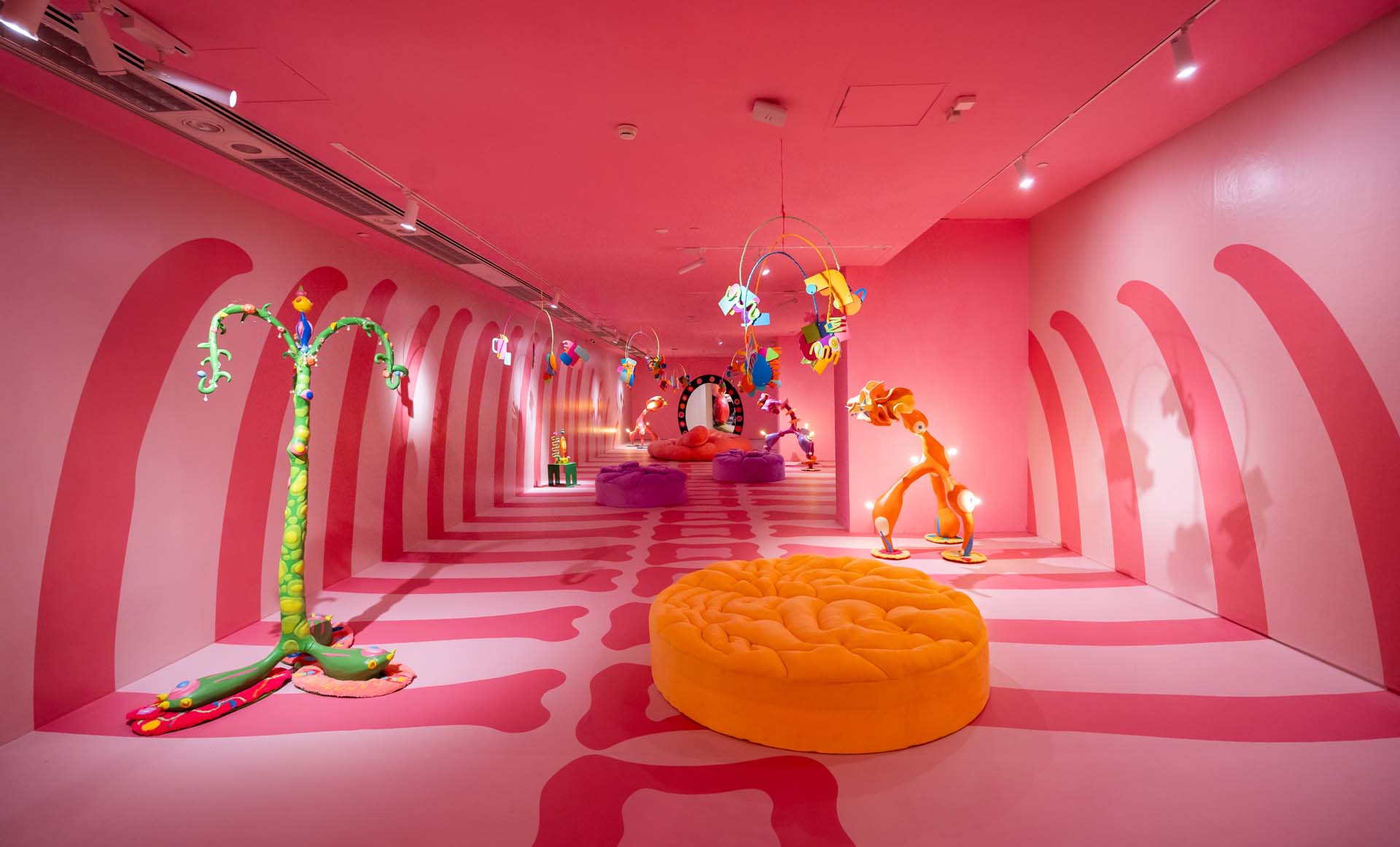
Step into Ekokaxi Wang’s world and the familiar rules no longer apply. Elephants can have bunny tails, creatures communicate through shapes and colours, and visitors are invited to touch, play and wander through an imagined dimension where almost anything is possible.
This is the universe of “Echo the Wind Wanderer”, the flagship exhibition of the 3rd Macao International Children’s Arts Festival. The exhibition was built from clay, paper, yarn and sponge, but shaped above all by Ms Wang’s fascination with travel, childhood curiosity and the possibility of worlds beyond our own. Organised by the Cultural Affairs Bureau (IC) and jointly presented with MGM China Holdings Ltd, the exhibition opened on July 26 and runs until October 11 at both the Macao Museum of Art and MGM Cotai.
For the artist, however, the journey into this parallel world began long before the exhibition took shape. It started with the simple act of travelling.
“I love traveling. A lot of times, traveling is like unlocking a parallel world for me,” Ms Wang says. “The travels I’ve done on Earth have been revealing so many different possibilities of life, customs, rituals, aesthetics and values.”
Those experiences planted a question that has occupied her for more than a decade: what would it be like to travel across dimensions altogether? “What would I see, and how could I recreate that for people on Earth to see?”
The answer became the world of Echo, a dimension built, quite deliberately, on the absence of the rules that govern this one.
“In the other dimension, it would be a safe environment, with no judgement and no rules. Even evolution would happen differently. Language is no longer needed; every creature would communicate in shapes and colours, with no more misunderstandings,” she explains, laughing as she describes one of its inhabitants: “Elephants would have bunny tails because there are no flies or mosquitoes.”
The exhibition’s title character, Echo, is not a mascot invented for the occasion. It is a name Ms Wang gave herself as a child, and one she has carried ever since.
“Echo is the name I chose for myself when I was seven, with the influences of Echo Chen (Sanmao), the Taiwanese writer, and Echo, the mountain nymph who lived on Mount Cithaeron,” she reveals. “I would always go back to Sanmao’s writings, the free, emotional exploration of a world she created with words. And for the mountain nymph, I would always dwell on the concept of Narcissus and Echo: the mirror, the reflections, the action of watching and being watched.”
That idea of the mirror runs throughout the exhibition. “I think, in a way, the exhibition functions as the mirror itself,” she says. “The audiences come in and see the reflection of themselves within the exhibition. And it’s a mirror for one’s inner child to be reflected, to re-emerge. A mirror that would shake off everyone’s role in society. A mirror that would break all the rules and regulations.”
Clay, chopsticks and stones
Ask Ms Wang about her creative process and the answer has less to do with fine-art supplies than with objects most people would throw away.
“I always collect recycled items to make them into sculptures. Underneath the mock-ups, there would be chopsticks or boxes, and I would always paint with straws and cotton sticks. I would dig out clay from the mountains, collect stones from riverbanks and fire them in kilns,” she says. “No need to buy fancy art stuff. Collect some junk, go dig some dirt and play.”
Among the exhibition’s sections, “Re-coding Macao” occupies a particularly personal place, rooted in a life that has rarely remained in one place for long.
“I had a fairly complex background growing up,” she recalls. “I had to move between a lot of places – the United States, Korea, different parts of China – and I moved to Australia at the age of 14, spent 10 years in Melbourne, then I went to do my masters in the United Kingdom for four years.”
That constant movement left its mark. “I feel like a stranger and a misfit in my actual hometown, and I had a long period of time when I didn’t know where home was,” the artist explains. “I have been in a state of cultural exile for many years, feeling dislocated, alienated from my native culture and unable to find a sense of belonging.”
Macao, unexpectedly, offered something different. “From the first time I was in Macao, it felt so familiar that it felt like home. And it was such a strange feeling to call a place you had just visited for the first time home,” she says. “It was a moment when I saw the possibility of all those different cultures coexisting in such an embracing, harmonious way. In a way, it made me love myself and my own existence.”
That feeling became the raw material for “Re-coding Macao”, according to the artist. “I have visited a lot of places in Macao and documented the shapes and colours that I felt were communicating with me. I love the artistic, historical and cultural aspects of Macao,” she says, naming the places that moved her most: “Our Lady of Sorrows Church in Coloane, the Old Protestant Cemetery with the Morrison Chapel, and Cheoc Van Beach.”
Behind the glass
If the exhibition insists on being touched, it is because the artist has long resisted the conventional practice of keeping art at a distance.
“I have always had a problem with art being presented in a sterilised environment, behind glass and in a white box,” Ms Wang notes. “The glass between the audiences and the work is castrating the most important aspect of the artwork for me.”
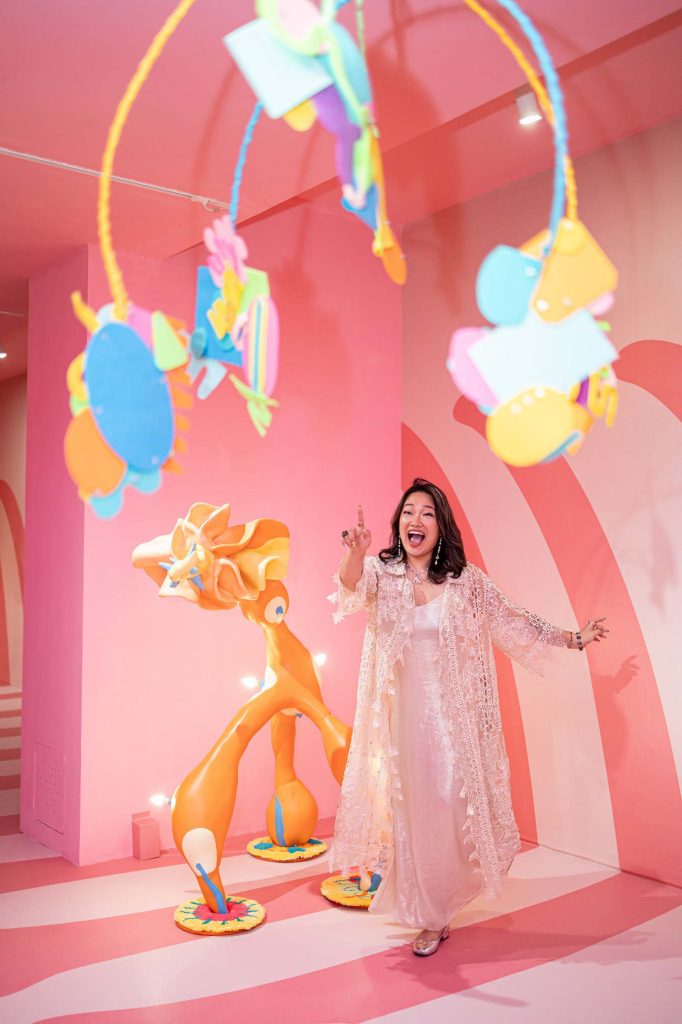
Her own artistic education began with a material that resists being sealed away. “As an artist who started my career working with clay, the tactility of clay has become such an important aspect of art for me. How to bring that sense of touch to my audiences has become the main focus of my research for the past decade,” she explains.
That research became academic as well as artistic. Her PhD thesis, “Tactile Play Art – An Art Therapy Research on Complex Post-Traumatic Stress Disorder”, sits at the intersection of play therapy, art therapy and tactile stimulation research. “I was so lucky to have the chance to bring this research to life by making this exhibition happen.”
Spread across two very different spaces, the exhibition adapts its approach to each.
“In the Macao Museum of Art, we have designed three different spaces for children: to be in an artist’s studio, to enter a giant’s body, and to build Macao. They can play, touch and feel in any way they want,” Ms Wang says.
At MGM Cotai, the ambition shifts, playing with human scale itself. “We wanted to create the whimsical wonder of entering a parallel world, where everything is off scale. In ‘Cabinet of Curiosities’, everything is to scale to daily life. In ‘Re-coding Macao’, we are the giants re-building the city. In ‘Aquarium Adventures’, we shrink down to enter a giant’s body. And in ‘Animals from the Parallel Universe’, big becomes small, and small becomes big.”
An unfinished exhibition
For the artist, the impulse behind all of this can be traced back to a single childhood memory.
“When I was three years old, I did a painting of a giraffe. The giraffe’s neck went out of the edge of the paper and came back in,” she recalls. “My mom was so touched by that painting. She kept telling me how talented I was, praising how I could think outside of the box. That was one of the very few memories I could remember from my childhood.”
That early encouragement, she believes, helped shape everything that followed.
“The encouragement and protection of my creativity and curiosity have made a great impact on me today. People would say the artworks look like they are made by a child, and I think that’s the best compliment I could have possibly received,” she highlights.
For her, the significance reaches beyond her own artistic practice: “To keep that childlike wonder in the world, to be excited about every beautiful leaf on the side of the path. It is to let children know there are so many different possibilities in life, and there’s more than one designed path.”
Asked what she hopes visitors will take from the experience, she deliberately offers no fixed answer.
“I don’t have any expectations of that. I am free, as my audiences are free as well,” she says. “Every audience’s interpretation, participation and reading of this exhibition makes it into a new exhibition. I have only completed 50 percent of the exhibition by making all the artworks. It is through each individual’s own interpretation that the exhibition is completed.”
And when asked what has most shaped her approach to imagination, childhood and storytelling, her answer needs little elaboration.
“Nature,” she says. “Nature rewards its bravest children. My mother always said, nature has all the answers. I am thankful to have nature with us.”
Her invitation remains open: to touch what most museums keep behind glass and, if only for an afternoon, rediscover the childlike curiosity that Ms Wang has spent a lifetime refusing to leave behind. es.