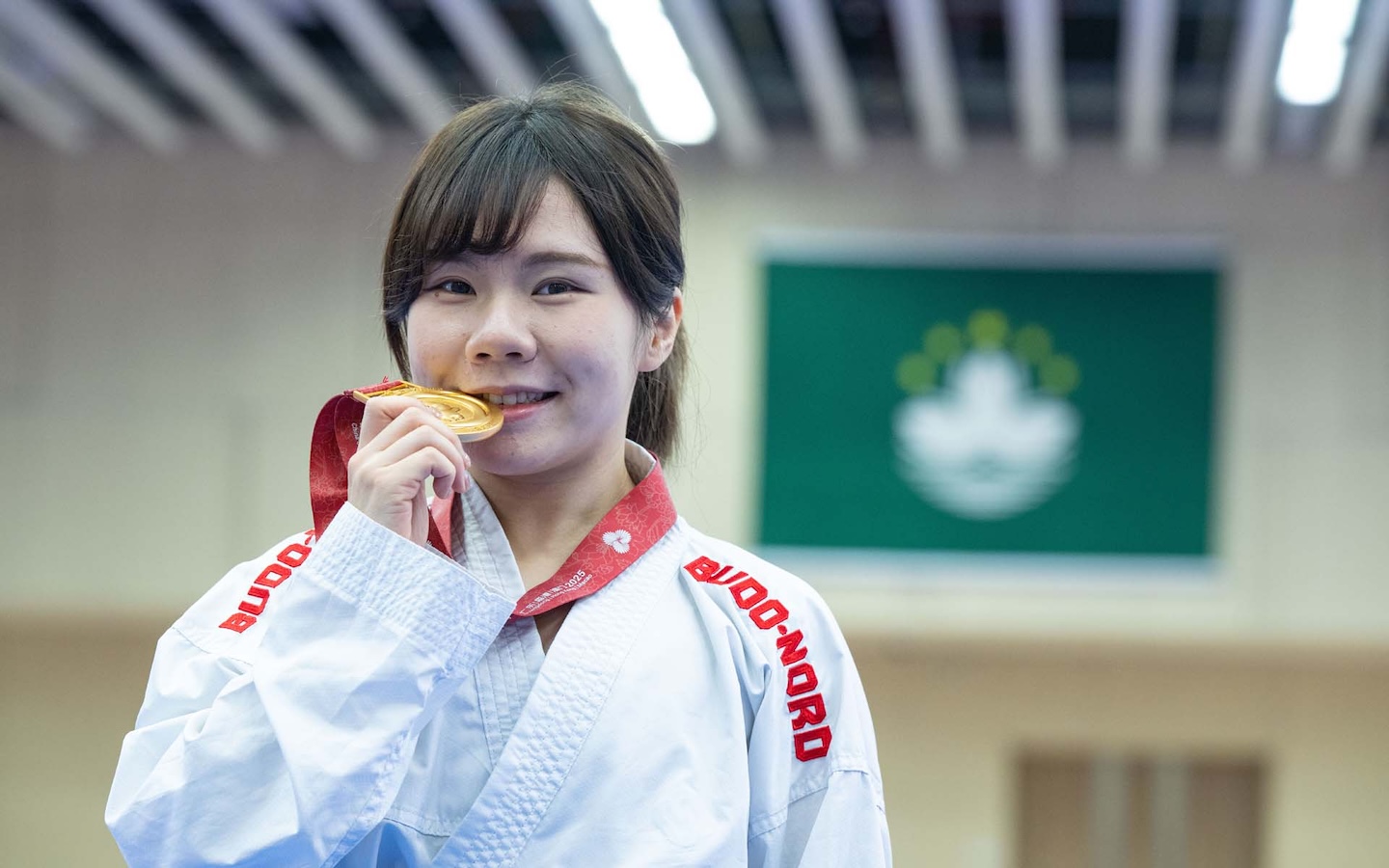
Last November, Macao witnessed a watershed moment in its sporting story. On the tatami of the 15th National Games of the People’s Republic of China, 26-year-old karateka Fong Man Wai clinched gold in the women’s under‑55kg kumite event, becoming the first female athlete from Macao to win a title at the Games.
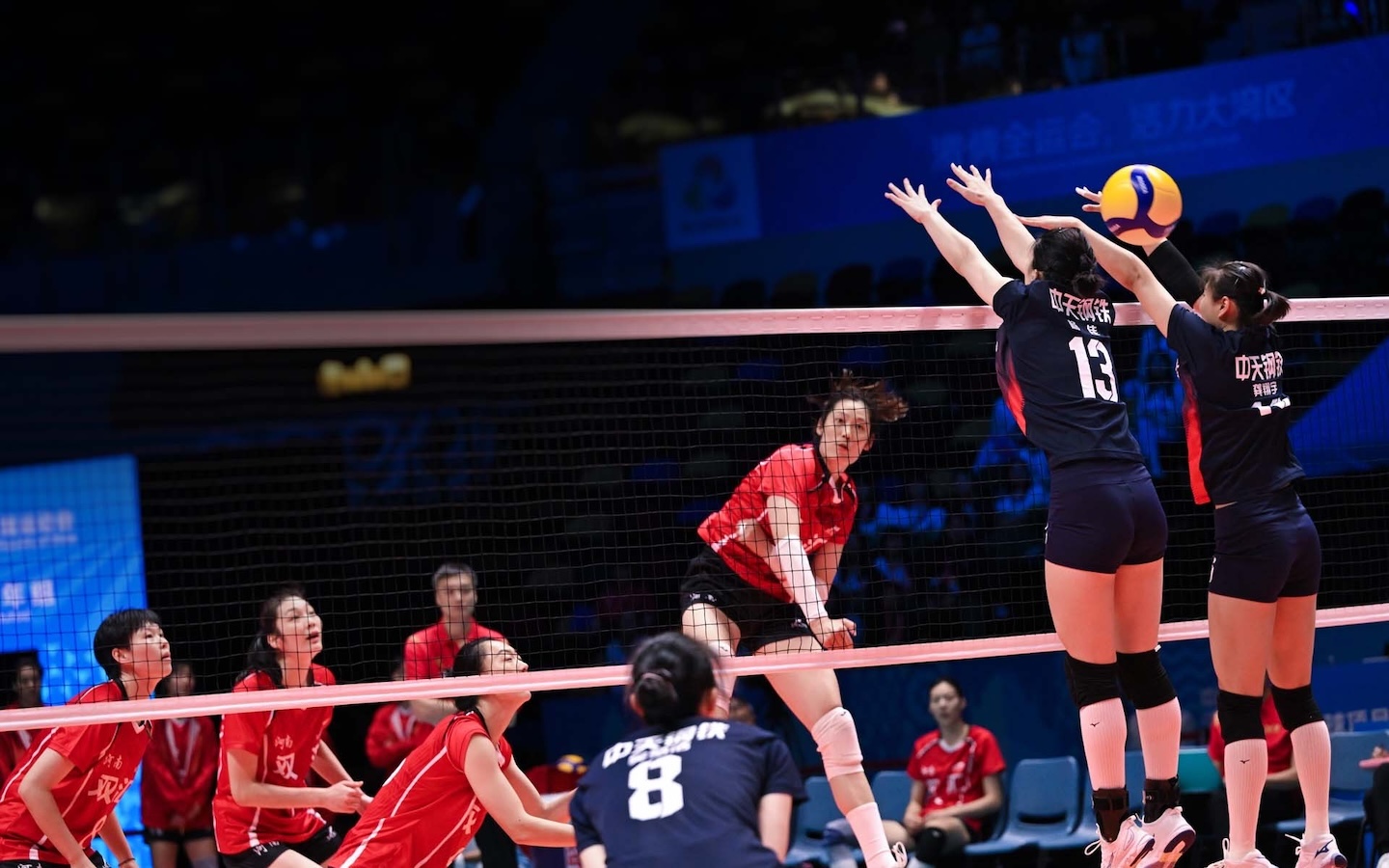
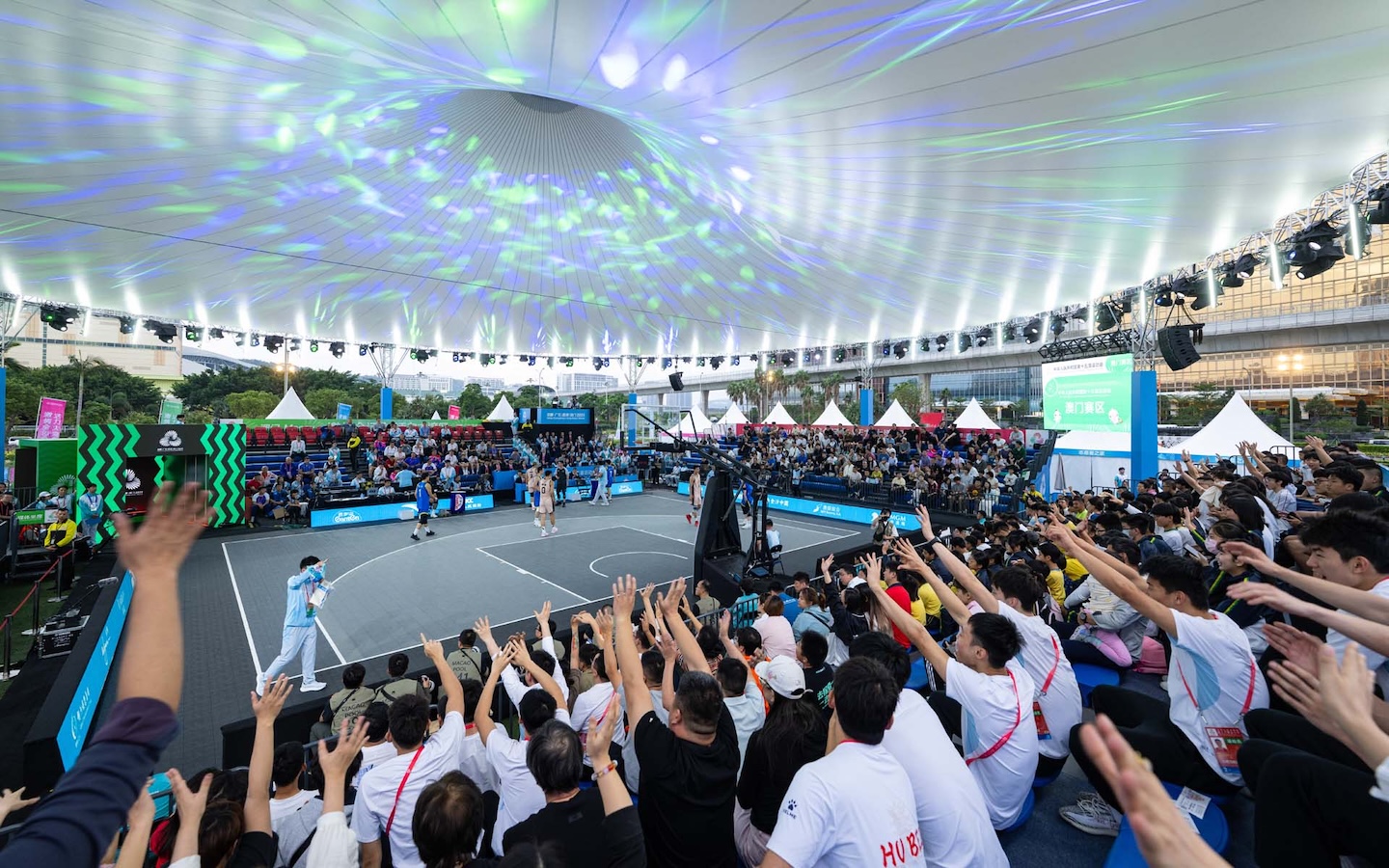
The achievement carried added resonance. Her victory came on home soil, as the Macao Special Administrative Region (SAR) co-hosted the Games alongside Guangdong province and the Hong Kong SAR.
Ms Fong’s journey into karate began at the age of 12, when her mother introduced her to the sport through an uncle. At first, her motivation was simple.
“When I was a teenager, I started to gain weight and my classmates picked on me,” she recalled in an interview with Macao Magazine. “Practising karate was just a hobby, a way to slim down. I wasn’t ambitious at all in the beginning.”
Double happiness
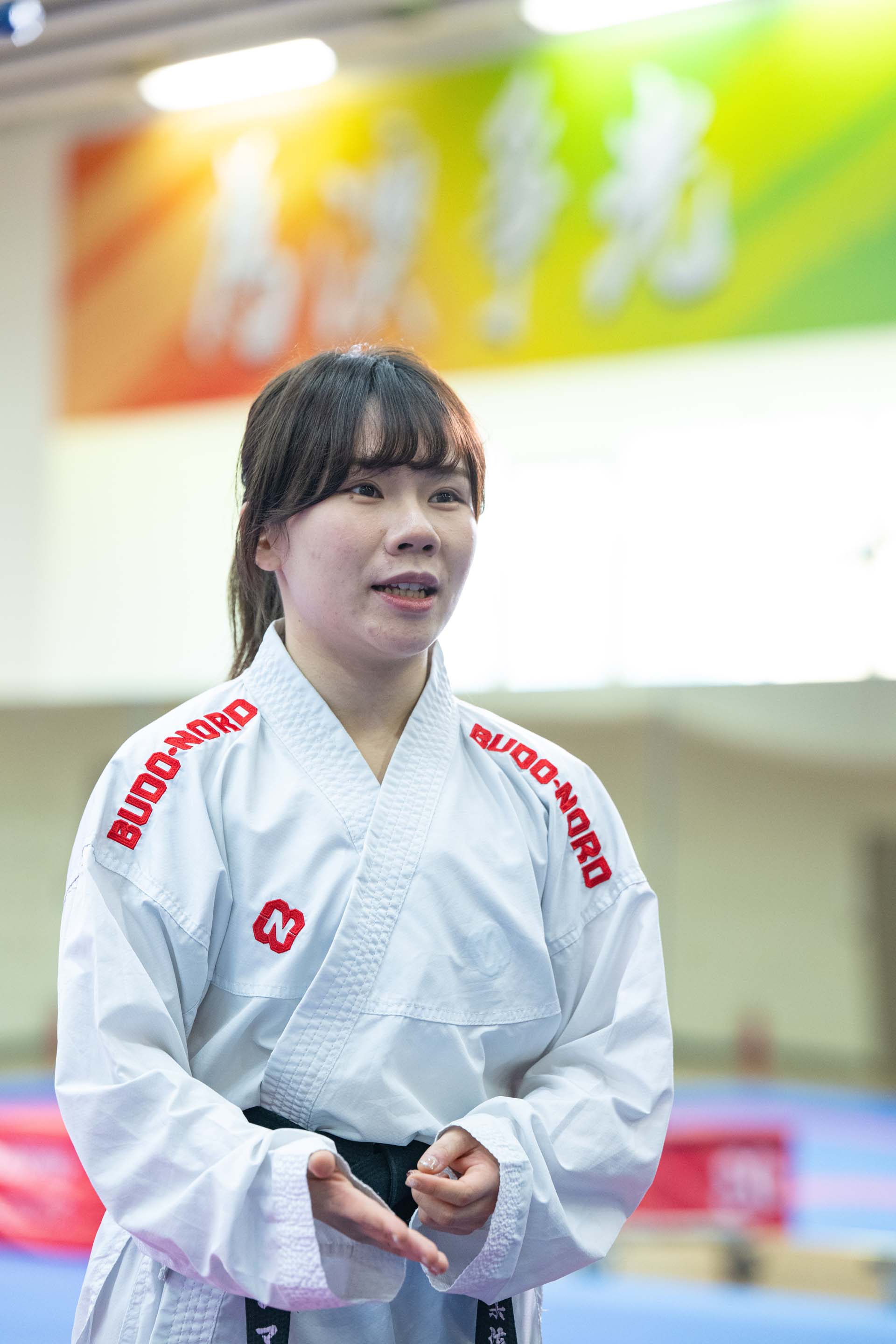
What began as a pastime soon revealed itself as a calling. One family member, in particular, would shape the course of her sporting life: her younger brother, Fong Man Hou, a fellow member of Macao’s karate team. Ms Fong admits that envy of her brother’s early successes initially drove her forward, but what began as sibling rivalry gradually evolved into a deeper passion for the sport.
She became fascinated by the contrast she observed in elite athletes: playful and relaxed away from the tatami, yet intensely disciplined and focused once competition began. That persuaded her to take karate seriously, and it soon became the defining pursuit of her youth.
When she first committed herself to a competitive path, her parents worried that her enthusiasm might prove short-lived. Over time, however, her persistence and discipline reassured them, and they became her strongest supporters.
Success followed. Ms Fong began collecting medals and trophies, including an early international breakthrough in 2018 with a bronze medal at the Asia Junior & Cadet and U21 Championships in Okinawa, Japan.
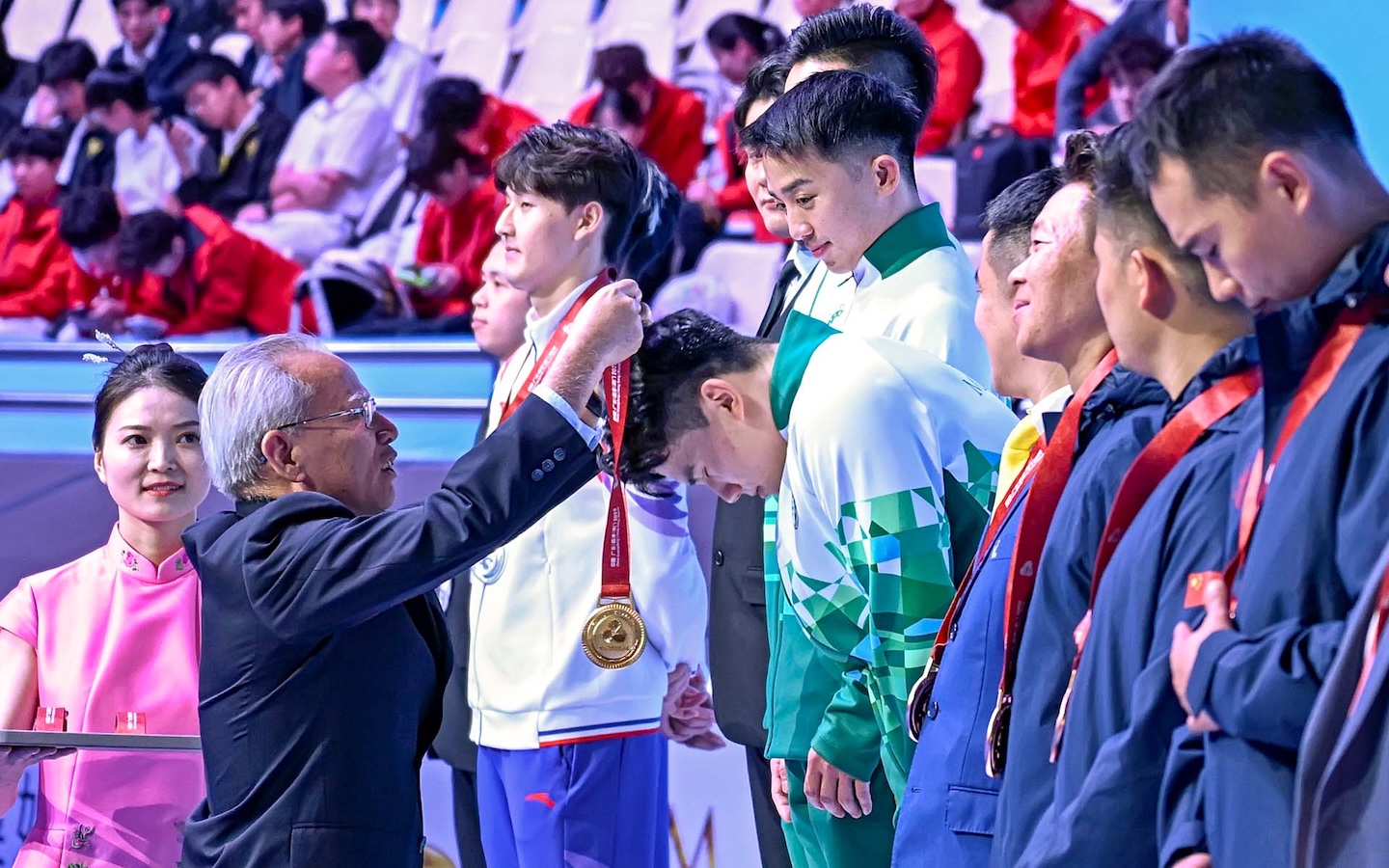
Fast forward to November last year. Anticipation was high in Macao as the city hosted a number of sporting events as part of the National Games, including karate. On November 6, the Macao karate team secured first place in the men’s team kata category – the territory’s first-ever gold at the Games. Among the team members were Kuok Kin Hang, Iong Kuang Hou and Fong Man Hou, Ms Fong’s younger brother.
Two days later came another surge of celebration. Ms Fong carved her own place in history, winning Macao’s first-ever National Games gold medal in a women’s competition.
Despite her petite frame, according to her coach, Supa Ngamphuengphit of Thailand, what sets Ms Fong apart is her speed. “She has learnt to turn her weakness into her greatest advantage,” said Mr Supa, himself a kumite gold medallist at the 2017 and 2019 Southeast Asian Games. “She uses her stature to fight faster, and her speed continues to improve whenever she gives her best.”
Ms Fong first caught the attention of Macao’s karate community after winning an event at the sport’s Macao Open. The memory remains vivid. “That was the first time I truly challenged myself and succeeded,” she said. “Even now, I can still recall the joy of that moment. It was because I wanted to hold on to that happiness that I decided to join the Macao team and take on bigger challenges.”
Training and meditation
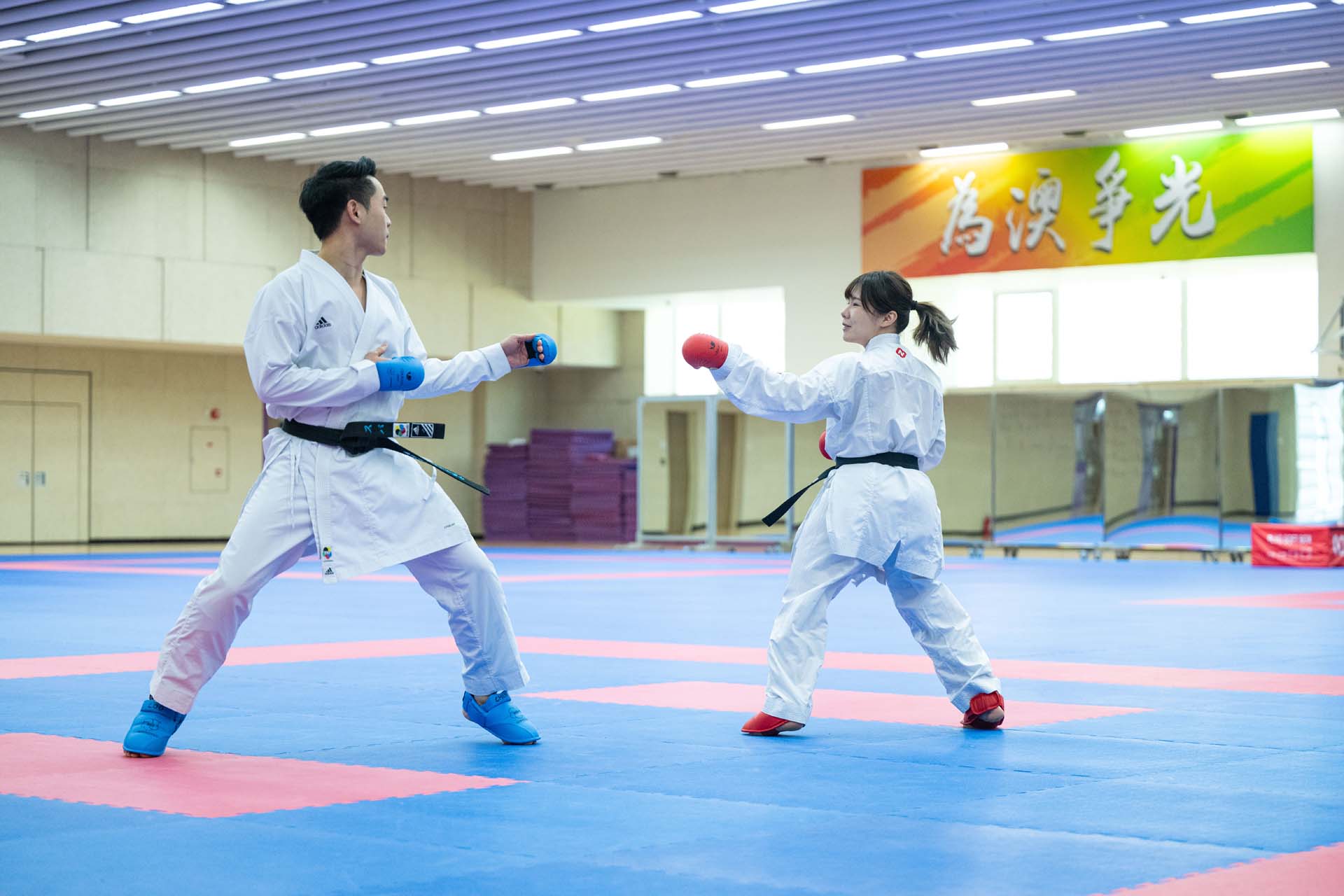
Preparation for the 2025 National Games began four years earlier. A series of training and funding programmes were launched to nurture athletes capable of representing Macao. These initiatives extended beyond routine practice, incorporating specially designed courses and intensive training sessions. Many athletes trained at least 10 hours a week as required by the programme, and on top of this, they had to put in their own regular 15 hours of weekly training.
Selection to represent Macao in the 15th National Games was highly competitive. Athletes had to place in the top eight at least once across two preliminary rounds to secure a spot in the final selection stage.
One of Ms Fong’s fiercest competitors was a younger teammate whose talent sharpened her resolve. “At my very first preliminary, I took first place and earned a seeded qualification,” she said. “My younger peer finished third, and together we advanced to the final stage.”
Securing her place in the National Games squad was an emotional milestone. “I was overwhelmed with happiness,” she said. “It gave me even greater anticipation for the future – an eagerness to keep that feeling alive and to continue striving for more.”
The Games themselves presented new challenges. Accustomed to competing in the under-50kg category, Ms Fong had to move up to under-55kg – the lowest weight class available for women at the Games – placing her against taller and stronger opponents.
“She is shorter than the other athletes in this category, so we needed to work harder,” her coach said. Training focused on enhancing her speed, agility, and footwork, enabling her to outmanoeuvre physically larger competitors. She also sparred regularly with male athletes to adapt to faster, more demanding bouts.
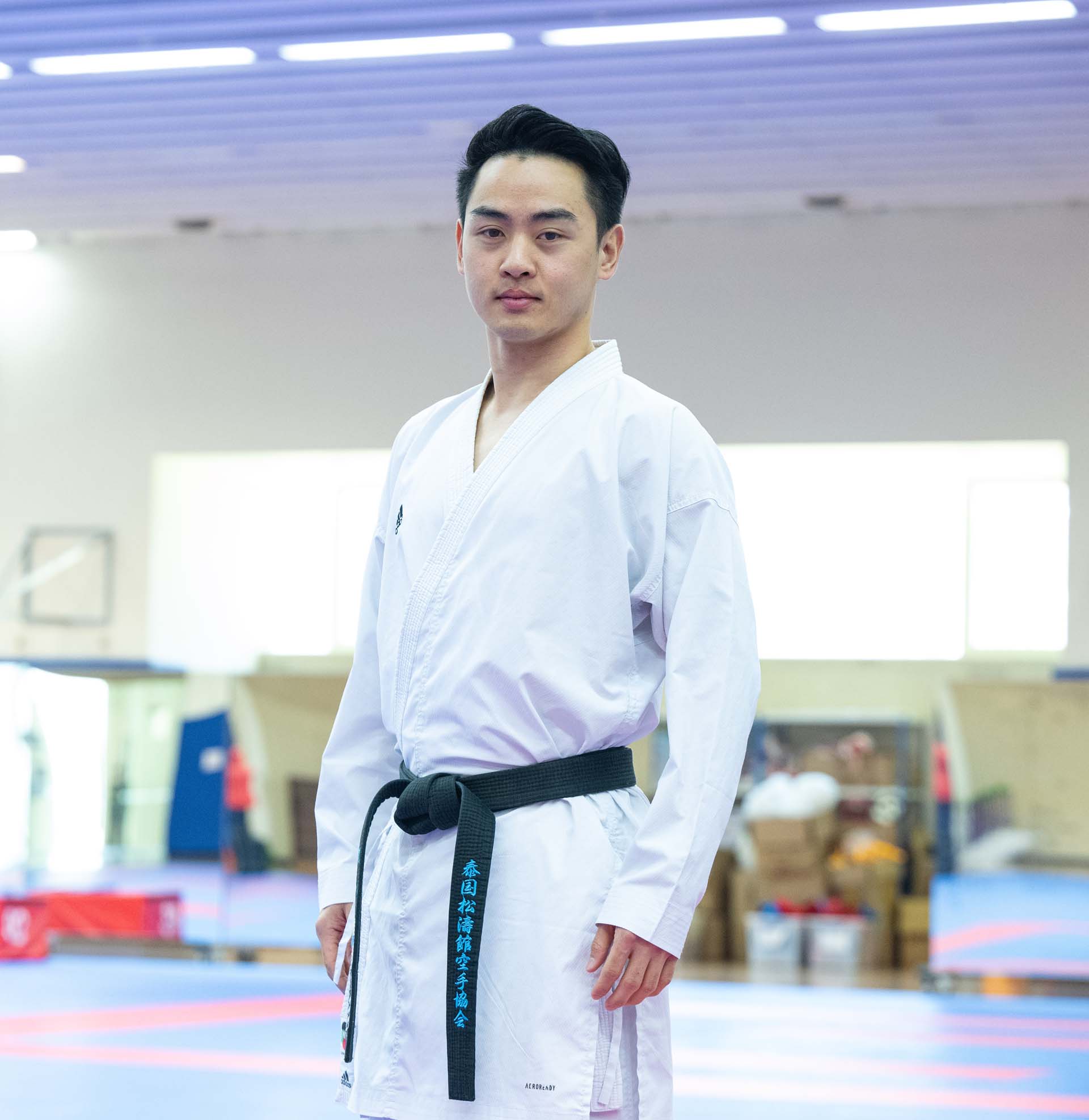
Mental preparation proved equally important. Mr Supa introduced meditation as a core component of training, helping athletes manage pressure during competition.
“For the National Games, we prepared for four years to reach the final,” Ms Fong said. “It would be a great pity to lose because of nerves or psychological instability – and that happens often. Meditation was a core element of my success in winning the gold medal.”
The golden moment
When her name was announced as the gold medallist, Ms Fong said she was overcome with gratitude. “At that moment, I was not just happy for myself,” she recalled, “but for the entire environment – the people who supported me, the audience who cheered, and the sport itself.”
Behind the success lay years of hard work. During the most difficult periods, she said, her greatest source of support was her younger brother. “He was not only family, but also my teammate. We grew up together, entered the Macao squad side by side, and our lives and training became almost completely intertwined.”
Macao shared in her triumph. Chief Executive Sam Hou Fai publicly congratulated the Macao karate team for securing three gold and two bronze medals overall at the 2025 National Games.
Ms Fong’s success did not emerge in isolation. It builds on the legacy of earlier female karate athletes from Macao, including Paula Carion, now retired, who represented the SAR internationally and won multiple medals at Asian-level competitions.
“In Macao, people traditionally expect girls to pursue gentler, quieter hobbies,” Ms Fong said. “With this first National Games gold medal for women’s karate, I feel it is not only a personal milestone but also a chance to inspire other girls. I want the next generation of athletes to carry forward our efforts, step confidently onto the international stage, and strive for more medals and greater success.”
Participation in karate has been steadily increasing in Macao. Yet Ms Fong believes the local karate community still has room to grow. “We hope that through this achievement more resources will be invested, encouraging wider involvement and inspiring more people to take part,” she said.
She intends to contribute to that growth beyond competition. Alongside her athletic career, Ms Fong has earned both a bachelor’s and a master’s degree in physical education and sports science, followed by a postgraduate diploma in education at the University of Saint Joseph in Macao.
“I hope to use schools and other channels to introduce more young people to karate, offering them a new stage on which to showcase their talent and giving them greater opportunities to develop,” Ms Fong says.
Next mission: Asian Games
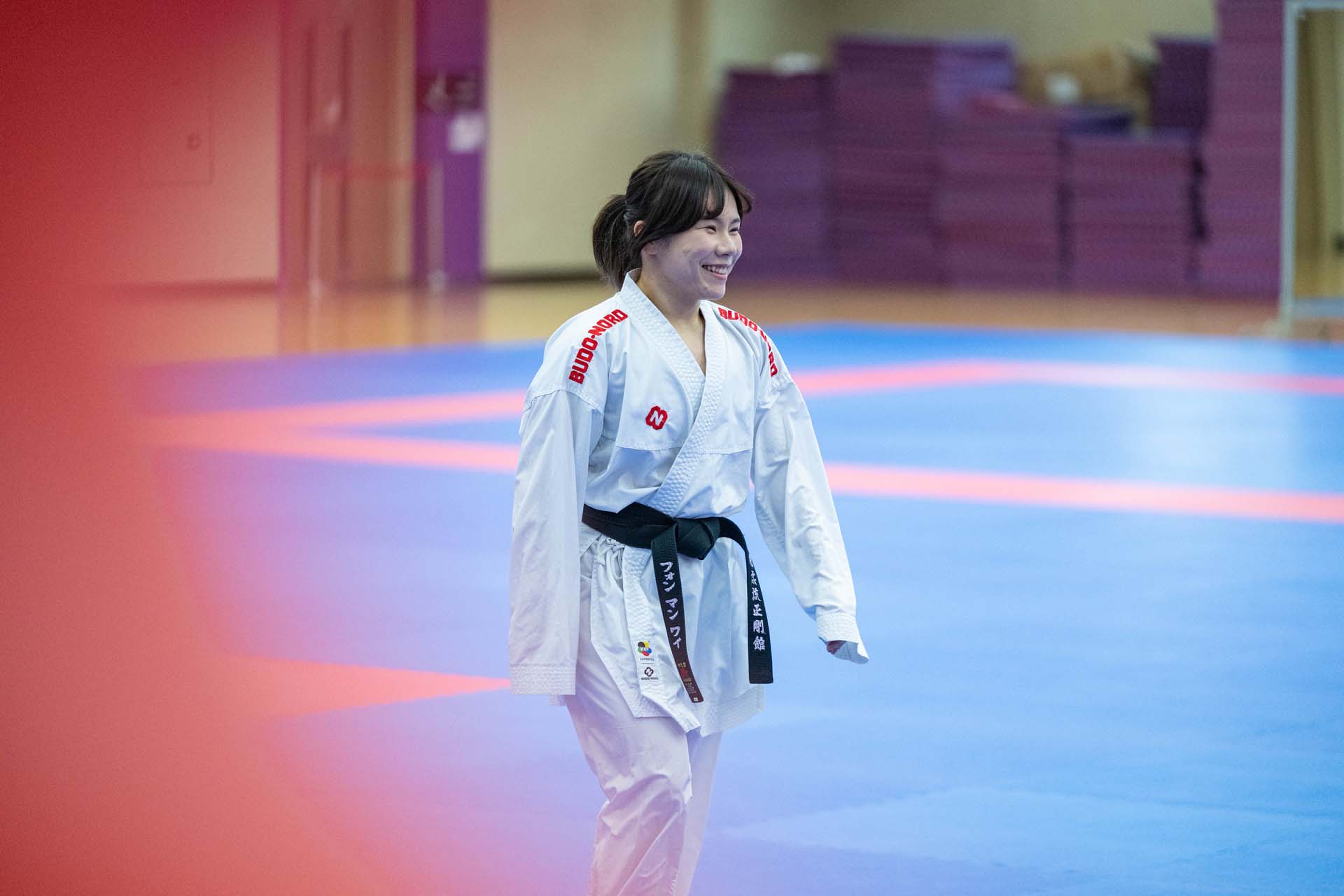
For now, her focus remains on competition. Ms Fong plans to stay with the Macao team while completing her professional training as a sports educator.
“As long as I still have the ability, retirement from competition is not something I will consider,” she said. “When the time eventually comes, I hope to devote myself to coaching or education.”
Her immediate target is the 2026 Asian Games, to be held in Aichi prefecture, Japan, from September 19 to October 4. With just months to go, preparation is in full gear.
The event will mark her second appearance at the Asian Games. She made her debut in Hangzhou in 2023, after that edition of the Games was postponed from 2022 because of the Covid-19 pandemic: she exited in the quarterfinals. “Although I did not win a medal in my first outing, this time I am determined to challenge for gold,” she said.
Looking further ahead, Ms Fong remains confident about the future of karate in Macao. “Watching the progress of my younger teammates only strengthens my conviction that this goal will, in time, be realised.”