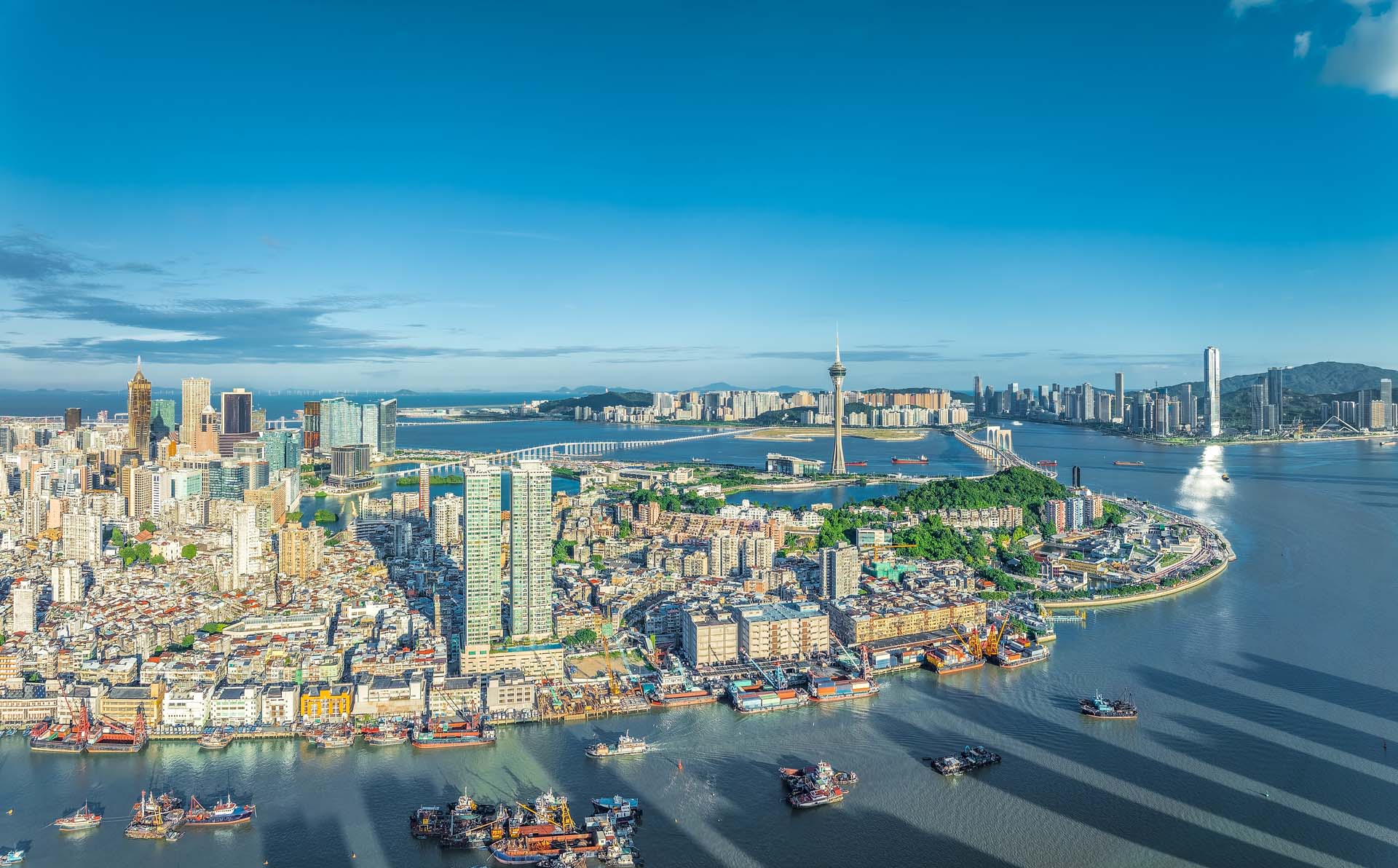
By the end of this decade, the city envisioned by the Macao Special Administrative Region (MSAR) Government should look, and in some ways function, quite differently from today. The economy should be less dependent on gaming, while Hengqin should be more closely integrated into the economic and everyday life of Macao.
Old neighbourhoods will also undergo substantial renewal, while public transport, environmental performance and healthcare provision should improve. Education, scientific research and talent development are also expected to become increasingly connected to the city’s economic transformation.
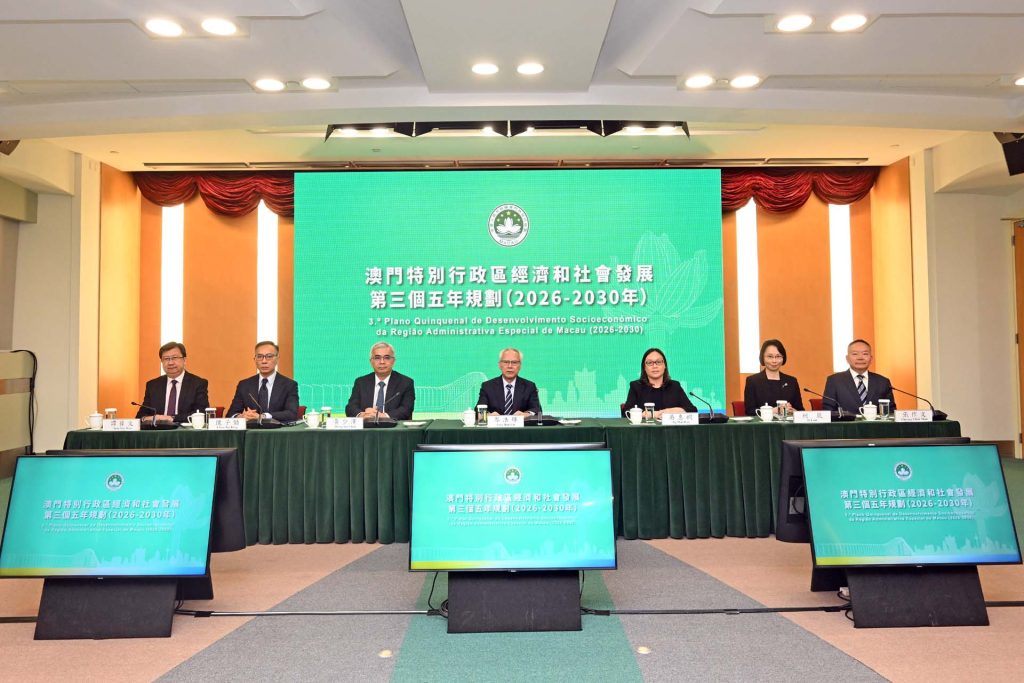
These ambitions are outlined in the Third Five-Year Plan for Economic and Social Development of the MSAR, covering 2026 to 2030.
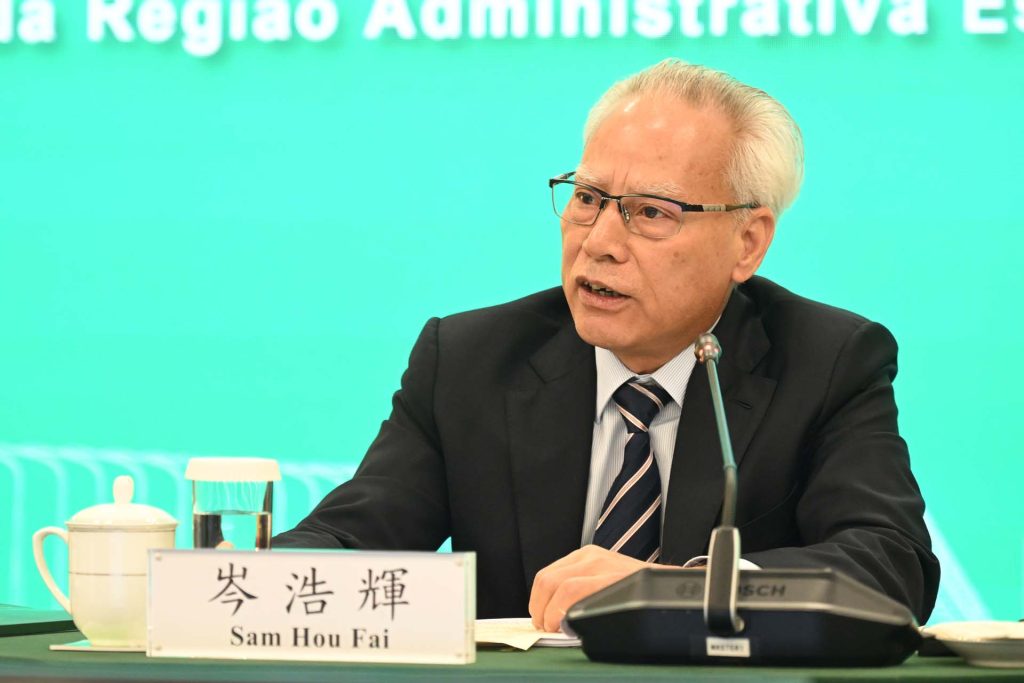
Unveiling the plan in August, MSAR Chief Executive Sam Hou Fai described the occasion as a major milestone for the city.
“Today is a particularly important day for Macao,” he said at the press conference announcing the document, describing the formulation and launch of the plan as an undertaking of major significance for both the Government and society.
The document is the MSAR Government’s roadmap for what Mr Sam called a new stage of “high-quality development”. It establishes eight “major development goals” and 35 major economic and social indicators, spanning economic diversification, public welfare, infrastructure, environmental protection and Macao-Hengqin integration.
The plan also sets out a broader vision built around four concepts: a “Law-based Macao”, “Vibrant Macao”, “Cultural Macao” and “Blissful Macao”, Mr Sam noted.
The document, stated the Chief Executive, “represents a significant innovative step in deepening Macao’s practising of the ‘One country, two systems’ principle, and Macao’s alignment with national development”.
Mr Sam also said the country’s 15th Five-Year Plan had set “new directions and opportunities” for Macao. “The MSAR Government has proactively positioned Macao within the broader national development framework, actively implementing the national plan’s provisions within Macao, and strengthening alignment with Guangdong Province and the Hong Kong SAR, in order to promote coordinated development in the Guangdong-Hong Kong-Macao Greater Bay Area,” he added.
Economic diversification
Behind the guidelines announced by the Chief Executive is an extensive programme covering almost every aspect of life in Macao, according to the full report of the MSAR’s Third Five-Year Plan.
Although the economy has recovered and public finances remain relatively strong, the plan identifies the city’s narrow industrial structure among unresolved issues. It also points to employment, transport, healthcare and education as areas requiring attention, alongside the longer-term pressures created by an ageing population and low birth rate.
The response is a plan centred on four strategic tasks: economic diversification; deeper Macao-Hengqin integration; urban renewal and the construction of a greener and smarter city; as well as the forging of stronger connections between Macao, the rest of the country and the wider world.
The most significant economic target is also one of the clearest: by 2030, the MSAR Government wants non-gaming industries to account for approximately 60 percent of Macao’s gross domestic product (GDP). The figure stood at 56.7 percent in 2024, according to the baseline used in the plan.
Diversification is at the centre of the city’s economic transition, Mr Sam stated. The Government, he said, would combine Macao’s “advantages and resources”, increase policy support and capital investment and give greater play to the market and to enterprises in developing the “1+4” industrial structure.
Under the “1+4” framework, the Government has identified four emerging economic pillars alongside tourism and entertainment: the “Big Health” sector, notably Traditional Chinese Medicine; high-end manufacturing and technology; modern finance; and sectors including sports, culture, conventions and exhibitions.
These “emerging industries” accounted for about 13.8 percent of Macao’s GDP in 2024, a figure that should “increase progressively” until 2030, according to the document.
The plan calls for the gaming industry itself to develop “in an orderly and healthy manner in accordance with the law”, while tourism becomes more diversified and increasingly connected with culture, entertainment, sports, events and the community. The intention is to spread visitor spending more widely and create economic activity beyond the traditional tourism areas.
Conventions and exhibitions, for example, are expected to attract events related to sectors such as Big Health and high technology. The Government wants to strengthen links between these events, integrated resorts and community commercial districts, converting visitor flows into business for local neighbourhoods.
The strategy also includes support for small- and medium-sized enterprises (SMEs), with an emphasis on digitalisation, technology and access to new markets.
At a larger scale, the Government plans to use a new guidance fund – an investment vehicle managed by professional teams – to attract private capital and support emerging industries. Four major development projects will provide physical space and infrastructure for the diversification drive, including the Macao-Hengqin International Education (University) Town, the Macao Science and Technology Research and Development Industrial Park, the Macao International Integrated Tourism and Cultural Zone, and the Macao International Air Transport Hub (Port) on the West Bank of the Pearl River.
The aim is to create industries capable of standing alongside tourism as sustainable sources of jobs, investment and growth, according to the plan.
Macao + Hengqin
If diversification is the economic objective, Hengqin is increasingly the space that will support such a transformation. The plan describes the Guangdong-Macao In-Depth Cooperation Zone in Hengqin as key to “breaking the impasse” in Macao’s economic diversification. By 2030, the combined added value of Hengqin’s designated industries – including cultural tourism, conventions and exhibitions, Big Health, finance, technology research and advanced manufacturing – is targeted to account for at least 65 percent of the region’s GDP.
Mr Sam said the MSAR Government would “deepen the integrated development between Macao and Hengqin” and promote the high-quality construction of the Cooperation Zone, using technology and education as key drivers.
The Government would, he added, strengthen both the alignment of rules and mechanisms and infrastructure connections, while encouraging greater integration in areas including healthcare and elderly care.
The plan also highlights “hard connectivity”, involving infrastructure development, and “soft connectivity”, involving regulations and administrative systems. The longer-term ambition is for living, studying, working, starting a business and accessing services across the boundary to become progressively easier.
Healthcare and elderly services are specifically identified for deeper integration. Public services and social-security arrangements are also to be aligned more closely, with the stated aim of creating an environment in Hengqin similar to Macao for residents who choose to live and work there.
Education will be another major bridge. The first phase of the Macao-Hengqin International Education (University) Town started operations in August. The new University of Macau campus in the Cooperation Zone is scheduled for trial operation in 2028, while the main construction of campuses for Macao Polytechnic University and the Macao University of Tourism is expected to be “largely completed” by 2030.
The concept is closely linked to another priority: integrating education, technology and talent development so that universities contribute more directly to research, commercialisation and emerging industries.
One model envisaged in the plan is “research and development in Macao + transformation in Hengqin”, enabling ideas developed in Macao’s universities and laboratories to move toward commercial application across the boundary.
The Macau International Airport Hengqin Upstream Cargo Terminal, currently being developed in Hengqin, is targeted to start operations in the “first half of 2027”, with a goal of handling up to 300,000 tonnes per year.
A city renewed
Some of the plan’s most visible effects could eventually be found much closer to home. Urban renewal is among the four major priorities, with the Government promising to accelerate the redevelopment and rehabilitation of ageing neighbourhoods while establishing a sustainable mechanism to finance and manage renewal.
“We will accelerate urban renewal and build a beautiful and smart Macao,” the Chief Executive said, pledging to improve the legal framework, coordinate funding and policy resources, and establish a sustainable system for urban renewal.
Iao Hon is among the most prominent targets. Plans include the renewal of the neighbourhood’s seven clusters of old residential buildings, using approaches ranging from repair and reconstruction on the original site to relocation. Other projects include the Tamagnini Barbosa civil servants’ residential building and housing associated with the Red Market post office.
These efforts are intended to encompass more than housing. The Government wants old districts to gain better public facilities, leisure and sports areas, transport services and more attractive streetscapes. Six distinctive areas are to be created as part of efforts to revitalise community commerce and combine culture, business and tourism.
Around the Ruins of St Paul’s, the plan proposes conservation-led revitalisation. Measures include dealing with abandoned and dangerous buildings, improving signs and surrounding façades and introducing a pilot beautification and revitalisation area while protecting the World Heritage landscape.
Putting people first
Economic expansion and construction occupy much of the plan, but its success will also be measured in less immediately visible ways. The MSAR Government places the principle of “putting the population first” among the plan’s fundamental principles, stating that the benefits of development should reach residents more broadly and fairly.
That is especially significant as Macao’s population ages. The plan expects the number of people receiving old-age pensions to rise from 159,313 in 2025 to 184,700 in 2030, an increase of roughly 3.0 percent a year.
Healthcare capacity is also expected to expand. By 2030, the Government targets 3.8 qualified doctors per 1,000 residents, up from 3.4 in 2025, and 5.6 qualified nurses per 1,000 people, up from 4.8. Hospital beds are targeted to increase from 4.8 to 5.2 per 1,000 residents.
The Rehabilitation Hospital at the Islands Healthcare Complex is scheduled for completion in 2027. The plan also promises free community and preventive healthcare services for all Macao residents.
Housing is another measurable priority. The stock of public housing units is projected to rise from approximately 56,850 to around 71,600 by 2030.
The plan also addresses employment, childcare, youth development, culture and sport. It seeks to keep unemployment among local residents relatively low and maintain high participation in social-security arrangements.
The document states that the MSAR Government will optimise policies to support birth rates and promote further incentive measures, “seeking to continuously improve the quality of the population and foster balanced long-term population growth”.
The five-year transformation is accompanied by environmental targets. By 2030, the reduction in carbon-dioxide emissions compared with 2005 is expected to exceed 65 percent, while more than 60 percent of electricity purchased from outside Macao is targeted to come from non-fossil sources.
Public transport should account for between 55 percent and 60 percent of journeys, compared with 53.4 percent in the plan’s 2025 baseline.
The Government also intends to increase and optimise at least 200,000 square metres of green space across Macao and plant approximately 3,000 trees along green corridors, in parks and recreation areas.
Macao as a bridge
Another major pillar reaches outward. The Government intends to deepen Macao’s participation in the Greater Bay Area, strengthen cooperation with Hong Kong and the Chinese mainland, and expand the city’s traditional role as a link between China and Portuguese-speaking countries.
Mr Sam said in his speech that Macao should make better use of its “unique advantages” of having the support of the country while being connected to the world.
“We will actively participate in the high-quality construction of the Guangdong-Hong Kong-Macao Greater Bay Area and intensify cooperation with Hong Kong,” he said, while also expanding Macao’s platform role for exchanges between China and Portuguese-speaking countries.
That platform is now being broadened to include Spanish-speaking markets. The plan envisages developing a branch of the Service Centre for Economy and Trade between China and Portuguese/Spanish-speaking Countries (CECPS) in Macao and potential overseas branches in countries such as Brazil and Mexico.
Culture is another element of that bridge-building role. The proposed International Integrated Tourism and Cultural Zone is intended to attract leading international cultural works and performances, while Macao is expected to deepen exchanges with Portuguese-speaking countries, Southeast Asia and other places along the “Belt and Road”.
The first phase of the National Cultural Museum of Macao is scheduled to be substantially completed in 2029. Planning for an International Performing Arts Centre and International Museum of Contemporary Art is scheduled to start in 2027, with architectural designs and construction tenders targeted for 2030.
Overall, the scale of the document itself hints at the breadth of the undertaking. The Third Five-Year Plan comprises 10 parts, 36 chapters and 68 special columns.
The Chief Executive has made clear that publication of the plan is only the beginning. The Government says implementation will be organised through three lists: priority projects, responsibility for major tasks and significant reform measures. The idea is to translate broad policy objectives into specific assignments and strengthen accountability across government departments.
The plan itself emerged from 40 preliminary research sessions and 36 thematic studies. Its 40-day public consultation generated 1,716 submissions containing 8,230 opinions – 2.6 times the number received for the Second Five-Year Plan, the Government noted.
“Planning represents 10 percent of success; the remaining 90 percent depends on implementation,” the document stated. “As the implementation of the Third Five-Year Plan is a major responsibility, as well as a demanding task and an honourable mission, its success will depend on the contribution of all sectors of society and the entire population,” it added. For Macao, 90 percent of execution will unfold between now and 2030.
| Eight goals by 2030 |
|---|
| The Third Five-Year Plan identifies eight overarching development objectives for the 2026-2030 period: National security Fully implement the overall national-security approach and strengthen Macao’s capacity to safeguard national security Governance Improve law-based governance, deepen public-administration reform and increase government efficiency Economic diversification Make substantial progress towards a broader economy while reinforcing Macao’s role as a world centre of tourism and leisure Regional integration Advance the high-quality development of the Guangdong-Macao In-Depth Cooperation Zone and deepen integration between Macao and Hengqin Education, technology and talent Connect education and scientific research more closely with innovation and talent development People’s well-being Progressively improve social security, healthcare, housing, employment protection, culture, sports and youth policies Beautiful and smart Macao Accelerate urban renewal, improve transport and infrastructure, and strengthen environmental protection National development Deepen participation in the Guangdong-Hong Kong-Macao Greater Bay Area and strengthen Macao’s role connecting China with the world |
| Plan by the numbers |
|---|
| The Third Five-Year Plan contains 35 headline indicators. Among its most tangible targets: Economy • Non-gaming industries: around 60% of GDP • GDP: targeted to achieve stable growth • Resident unemployment: to remain at a relatively low level • Median monthly earnings of employed local residents: stable growth • Number of international visitors: stable increase Health and ageing • Qualified doctors: 3.8 per 1,000 residents • Qualified nurses: 5.6 per 1,000 residents • Hospital beds: 5.2 per 1,000 residents • Old-age pension recipients: 184,700 Housing and transport • Public housing units: around 71,600 • Public transport share: 55–60% • Natural-gas users: more than 35,000 Environment • CO2 emissions reduction versus 2005: more than 65% • Non-fossil sources in electricity purchased outside Macao: more than 60% • Waste treated harmlessly: 100% • Green space: at least 200,000 square metres added or optimised |